Choosing an extractor hob does not have to mean paying a premium for every available filtration feature. Before spending more, it is worth comparing what each model offers and deciding which features genuinely matter in your kitchen.
Extractor hobs - sometimes called venting hobs or downdraft hobs - have moved from a niche luxury to a realistic option for everyday European kitchens. They combine induction cooking and extraction in one unit, sit at the level of the pan rather than in a canopy above your head, and free up the wall or ceiling where a cooker hood would have gone.
The main barrier is often the initial price. Integrated extractor hobs can cost considerably more than a separate induction hob and cooker hood, particularly when premium filtration technology is included. Prices vary by country, retailer and configuration, so compare local EU offers rather than assuming every model costs the same across Europe.
For shoppers looking for a more affordable option, the key question is whether a lower-priced model still delivers practical everyday cooking and extraction. To make the choice clearer, we compare two 39cm extractor hobs side by side - the CBBEH3952-2B alongside its sibling with the Plasma⁺ air purification system.
The key takeaway is simple: the core cooking and extraction specifications are the same on both models, while the main difference is the additional air-treatment technology. For many households, the more affordable version may offer the functions they need without paying extra for a premium purification system.
Which Ciarra Extractor Hob Suits Your Kitchen?
| Your situation | Recommended option | Why? |
|---|---|---|
| You have a small flat or compact kitchen | Ciarra CBBEH3952-2B | A 39cm-wide, 2-zone design that combines cooking and extraction in one appliance |
| You want to keep your initial budget under control | Ciarra CBBEH3952-2B | A more budget-conscious option; check the current price in your EU country |
| You cook occasionally or prepare simple meals | Ciarra CBBEH3952-2B | A practical choice for lighter cooking without paying for additional air-purification technology |
| You regularly fry fish, cook meat or prepare aromatic dishes | CBBEH392B-OW Consider the Plasma⁺ version | Its additional air-purification system is designed to address persistent cooking odours |
| You have an open-plan kitchen connected to your living room | CBBEH392B-OW Consider the Plasma⁺ version | Odour management becomes particularly important when cooking smells can spread beyond the kitchen |
| You want to minimise routine filter replacement | Compare the maintenance requirements of both models | The standard model uses a washable zeolite filter, while the Plasma⁺ system is intended to reduce dependence on replaceable consumables |
| You frequently cook several dishes at once | Consider whether two zones are sufficient | Neither filtration system changes the limitations of a two-zone cooking surface |
Where the Two Hobs are Different
This is the part that makes the decision easier than it looks. Comparing the two models directly:
The Plasma⁺ model shares the cooking side of this specification. What it adds is a 2-stage air purification chain: a plasma field that breaks down odour molecules and UV-C light to sterilise the airflow. Ciarra quotes up to 99.9% removal of airborne pollutants for that system, and describes the filter media as self-cleaning with no routine replacements.
So the question is not "is Plasma⁺ better?" It clearly is, as an air purification system. The question is whether you need it - and that turns out to depend mostly on how you cook.
The short answer: Choose the Ciarra CBBEH3952-2B if affordability, compact dimensions and everyday cooking are your priorities. Consider the Plasma⁺ version if improved odour management and potentially lower long-term consumable costs are more important to you. Confirm the price and maintenance requirements available in your country before comparing total ownership costs.

First, what an Extractor Hob Actually Does Differently
A conventional setup pulls cooking vapour upwards into a hood above the hob. The problem is that vapour does not travel in a straight line. It drifts, it spreads, and in an open-plan room a fair amount of it escapes the hood entirely and ends up over your kitchen island, your dining table or your sofa.
A downdraft extractor works the other way around. The extraction opening sits at the edge of the hob, at pan level, so steam and odour are drawn away roughly where they are created rather than after they have risen a metre into the room. On a 39cm model, the extraction grille surrounds a narrow cooking surface, which is part of why the whole unit stays small enough to drop into a standard worktop run.
The other thing it does is give you your kitchen back. No canopy means no bulkhead, no duct run through a cabinet, no visual obstruction between the cooking area and the rest of the room. In an open-plan kitchen that is often the real reason people choose one.

The Hidden Cost Most People Forget: Filters
Here is the thing that catches out new extractor hob owners, and it is the same story whichever brand you buy. If your hob recirculates air rather than ducting it outside, the air passes through a filter, and that filter has a life. Traditional activated carbon cartridges cannot be washed. They saturate and stop working, and you replace them.
Replacement intervals depend on cooking habits, filter design and the manufacturer's instructions. As a general illustration, disposable carbon filters may need replacing more often in kitchens where frying and high-odour cooking are frequent:
Light use - occasional cooking, mostly steaming and boiling: around every 6 months
Normal use - daily cooking with some frying: every 3 to 4 months
Heavy use - daily frying, grilling or wok cooking: every 6 to 8 weeks
At typical local spare-part prices of varies by country and retailer, that is a recurring bill you keep paying for the life of the appliance:
Five-year filter cost for recirculating extractor hobs (illustrative estimates; actual costs and replacement intervals vary by EU country, retailer and manufacturer)
| Filter system | What you buy | Over 5 years |
|---|---|---|
| Standard disposable carbon cartridge | 2 to 4 cartridges a year; local replacement prices vary | Varies by local price |
| Washable zeolite (CBBEH3952-2B) | Nothing to replace - wash and refit | €0 |
| Washable zeolite with Plasma⁺ air purification (CBBEH392B-OW) | No routine consumables | €0 |
What Are the Benefits of a Zeolite Filter?
A zeolite filter is designed to help reduce cooking odours in a recirculating extractor hob. Zeolite is a naturally porous mineral with a structure that can adsorb certain gases and odour-causing compounds, making it a useful material for improving kitchen air quality.
Working alongside a grease filter, zeolite helps target odours that are not removed by grease filtration alone. In a Plasma⁺ system, it can work together with plasma-based air treatment as part of an additional purification stage.
Potentially lower ongoing filter costs: Depending on the model and the manufacturer's maintenance instructions, a zeolite filter may be reusable or designed for long-term use, reducing reliance on frequent disposable filter replacements.
Is a Zeolite Filter Enough on Its Own?
A zeolite filter is useful for reducing certain cooking odours, but its performance depends on the filter design, airflow, and maintenance. A Plasma⁺ system adds another treatment stage to the filtration process, which may be worth considering if odour control is a priority.
How Does a Plasma⁺ Filter Work?
A Plasma⁺ filter combines plasma-based air treatment with filtration to help reduce cooking odours and treat certain airborne contaminants. Unlike conventional cooker hood filters that mainly capture grease and adsorb odour compounds, it provides an additional stage of air purification.
In a multi-stage filtration system, the air passes through the grease filter first, followed by odour filtration and plasma treatment. The zeolite filter helps adsorb odour compounds, while the Plasma⁺ technology provides an additional treatment stage to help break down certain odour-causing substances and airborne contaminants. This combination helps tackle lingering cooking smells more effectively than relying on a single filtration stage alone.
After treatment, the air is returned to the kitchen in a recirculating system, helping reduce lingering cooking smells without requiring an external extraction duct. However, recirculating filtration does not remove moisture from cooking, so suitable kitchen ventilation may still be necessary.
Is a Plasma⁺ Extractor Hob Worth It?
A Plasma⁺ extractor hob may be worth considering if you have an open-plan kitchen or frequently fry fish, cook meat or prepare aromatic dishes. Its additional air-treatment technology is designed to help manage persistent cooking odours.
What's more, someone in the house has asthma, hay fever or allergies, or you have pets. Plasma filtration is aimed at airborne particles and allergens as well as cooking odour.
What the More Affordable Model Does Well
The reason we are comfortable recommending the entry model to most households is that the parts you interact with every day are the same parts you would get higher up the range.
1. Extraction that steps up when you need it
The four levels plus boost pattern is genuinely useful, because most cooking is quiet. Level 1 moves 155 m³/h at 41 dB(A) - background-level noise, easily low enough to talk over, and plenty for simmering or boiling pasta. Level 3, at 310 m³/h and 56 dB(A), handles ordinary frying without dominating the room. The 505 m³/h boost at 65 dB(A) is the one you use for searing, and only for a few minutes.
That graduated profile matters more than a headline extraction figure. A hob that only has "loud" and "louder" is unpleasant to live with; this one gives you a usable low end and a powerful top end.

2. Boost where it counts
The front zone takes 1,800 W normally and 2,200 W on boost, which is what gets a pan of water to a rolling boil quickly or puts a proper crust on a steak. The 120-280 mm pan range covers everything from a small milk pan to a 28cm frying pan, and the surface is frameless glass ceramic with touch controls, nine power levels and pan detection.
3. Small details that matter day to day
- 180-minute timer - long enough for a slow braise or a batch of stock
- Pause function - for answering the door without losing your settings
- Child lock - worth having if you have small children at hob height
- Twelve kilos - light enough for two people to lift into a worktop without drama
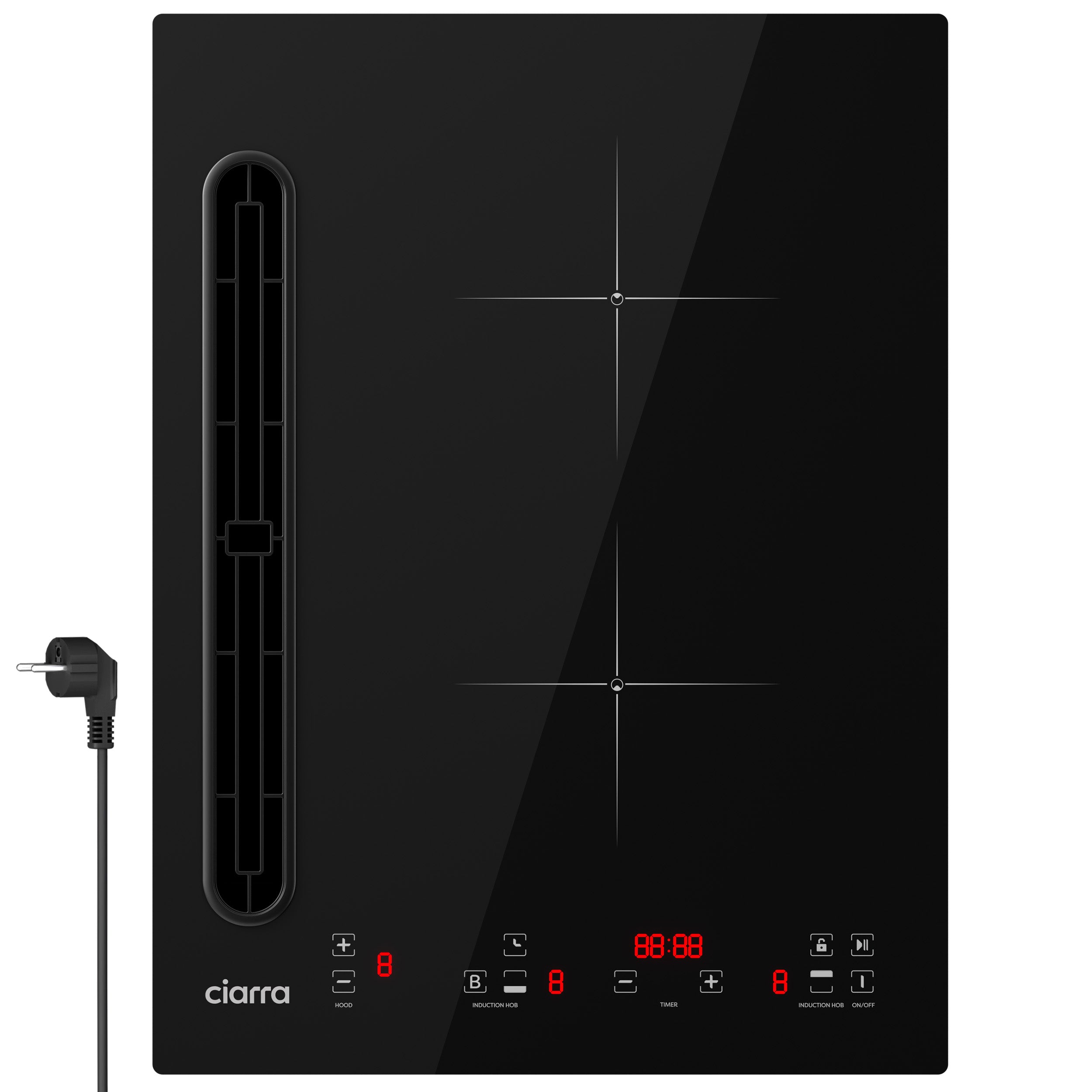
CBBEH3952-2B Affordable Extractor Hob- €699,99
Identical core components as top-tier models.
-
Smart 4-Level Extraction: Quiet background operation from 155 m³/h (41 dB) up to a powerful 505 m³/h Boost (65 dB) for heavy searing.
-
2200W Rapid Boost Zone: Fast boiling and precise searing. Fits 120–280mm pans on smooth frameless glass ceramic with 9 power levels.
-
Everyday Conveniences: 180-min timer, instant Pause button, Child Lock, and a lightweight 12kg design for easy installation.
What Should EU Buyers Know About Kitchen Ventilation?
A recirculating extractor filters air and returns it to the room; it does not discharge air outdoors. Whether additional ventilation is required depends on the property, installation and national rules.
There is no single set of building rules that applies identically to every EU country. National building regulations and local requirements may specify how kitchens must be ventilated, particularly in new-build homes, renovations or properties with fuel-burning appliances. Check the rules that apply where you live.
Because a recirculating extractor does not exhaust air outdoors, it cannot replace a required external mechanical ventilation system. If your project requires extraction to the outside, plan for a suitable ducted ventilation solution as well.
Requirements differ between EU member states and can depend on the building type and the scope of the work. Check the applicable national and local rules or consult a qualified installer before making a final decision.
Check the Worktop Cut-Out and Cabinet Space
The supplied installation information specifies a worktop cut-out of approximately 350 × 490mm and an appliance body height of approximately 245mm. Verify these measurements against the current installation manual before cutting the worktop.
Also check the space beneath the appliance. The supplied product information states that an oven cannot be installed directly underneath this model, so do not plan the kitchen layout around a conventional hob-and-oven arrangement without confirming compatibility.

Electrical Requirements: What Should You Check Before Installation?
Electrical planning is particularly important for an induction hob with an integrated extractor because the cooking element and extraction motor contribute to the appliance's total electrical demand.
The supplied figures are 3,200W for the hob and 165W for the extractor. If both figures represent simultaneous maximum demand, the combined load would be approximately 3,365W.
At 230V, that equates to approximately 14.6A. A standard EU 13A plug-and-socket arrangement is generally limited to around 3kW, so you should not assume that a conventional 13A socket is suitable for this appliance.
The final connection method, protective device and circuit design must follow the manufacturer's installation instructions and the requirements of the applicable electrical standards.
Is a 2-Zone Extractor Hob Enough for Everyday Cooking?
The Ciarra CBBEH3952-2B is designed for households that want an integrated extractor in a compact cooking surface. Its two-zone layout can be convenient, but it is important to understand the limitations before buying.
According to the supplied specifications, the hob has a front 180mm cooking zone rated at 1,800W, with a 2,200W Boost setting, and a rear 160mm zone rated at 1,200W. The stated total hob power is 3,200W.
Who Will Find Two Cooking Zones Sufficient?
A two-zone hob may suit you if you:
- Live alone or with one other person.
- Usually prepare one main dish and one side dish.
- Have a small flat, studio apartment or compact kitchen.
- Cook simple breakfasts, quick lunches and straightforward evening meals.
- Prefer to free up worktop space rather than install a full-size hob.
For example, you could use one zone for a saucepan of pasta and the other for a pan of sauce. For simple meals, that arrangement can be perfectly practical.
How Does an Affordable Ciarra Extractor Hob Compare With Premium Models?
Integrated extractor hobs span a wide price range across Europe. Premium models can cost substantially more than entry-level options, especially when they include advanced filtration, larger cooking surfaces or additional smart features.
Against that background, the Ciarra CBBEH3952-2B is positioned as a more accessible way to explore integrated cooking and extraction.
The value proposition is straightforward: it gives budget-conscious households the option of combining induction cooking and extraction in one appliance without automatically stepping into the premium price bracket.
For a household that prioritises affordability and compact dimensions, the standard Ciarra model offers a clear starting point. For households that cook frequently and place greater emphasis on persistent odours and reduced consumable use, the Plasma⁺ option is available.
You might be interested in:
FAQs
Does an Extractor Hob Need to Be Ducted Outside?
No, not when it is installed in recirculation mode: the air is filtered and returned to the room. However, local ventilation rules may require separate extraction to the outside in certain buildings or projects. Check the regulations that apply in your EU country before installation.
Do plasma⁺ filters need a carbon filter?
Plasma⁺ filtration is generally designed to replace the disposable carbon stage rather than sit alongside it, which is why plasma-based systems are described as having no routine filter purchases.
How Often Do You Replace the Filter in the CBBEH3952-2B?
There is no routine replacement. The zeolite filter is washable and reusable, which is what separates this hob from the disposable carbon cartridge cycle that most recirculating hobs still rely on.
What Pans Will Work on an Extractor Hob?
Any induction-compatible pan from 120 mm to 280 mm. If a magnet sticks firmly to the base, it will work. Glass, ceramic, copper, and most aluminium pans will not.
Can I Fit an Oven Underneath an Extractor Hob?
No. Ciarra advises against installing an oven or other appliance directly below an extractor hob, because the compartment beneath is part of the extraction and recirculation path.
Conclusion
Integrated extractor hobs can seem like a luxury, but choosing one does not have to mean buying the most expensive filtration package. A compact 39cm, two-zone model with pan-level extraction and a washable filter can be a practical starting point for smaller European homes, studio flats and households that usually cook with one or two pans. Check the current price, warranty and installation details in your country.
If you want additional air treatment and regularly prepare foods with persistent odours, the Plasma⁺ model may be worth considering. But if your priority is combining induction cooking and extraction in a compact appliance while keeping the initial budget under control, the standard model offers a more affordable route without changing the core cooking and extraction specifications.
News

Sustaining Quality, Elevating Kitchens: The CIARRA Story So Far

From IFA to KBIS: Ciarra’s Global Expansion and 8-Year Milestone


Comments
There are no comments yet.