Choosing an island cooker hood for a low ceiling can be challenging. You want an extractor that removes cooking smells, steam and grease effectively without hanging too low above your hob or making your kitchen feel cramped. This is particularly important in UK and European homes with compact kitchens, kitchen extensions, apartments and open-plan living spaces.
In this guide, we explain how to choose the right island cooker hood for a low ceiling, what installation clearances to consider and which alternatives may work better for your kitchen layout.
What Counts as a "low ceiling" in a Kitchen?
There is no legal minimum ceiling height for a habitable room in England, so "low" is a design problem rather than a compliance one.
The Building Regulations only require 2 m of headroom above a staircase. In practice, the numbers look like this:
| Ceiling height | What it means for an island hood |
| 2.3–2.4 m (7 ft 7 in–8 ft) | The standard modern UK ceiling. A slimline island hood or a ceiling-integrated unit fits comfortably. Full-height chimney island hoods are tight. |
| 2.1–2.3 m (6 ft 11 in–7 ft 7 in) | Genuinely constrained. Chimney hoods are out; slimline or downdraft only. |
| Under 2.1 m (6 ft 11 in) | Very low — typical of period cottages (1.8–2.1 m). Downdraft or flush ceiling extraction, with headroom treated as the design constraint. |
The UK National Space Standard requires 2.3 m over at least 75% of the gross internal area, rising to 2.5 m in London, so a large share of the housing stock sits below the height that mass-market island hoods are specified around. If your ceiling is a cottage 2.0 m, you are not an edge case — you are a very common one.
The Real Constraint: the Clearance Triangle
Clearance, ceiling height and hood depth are a closed system. Change one and the others move.
Manufacturers publish a "C" dimension — the distance from the cooking surface to the underside of the hood. Ciarra's island canopy specification, for example, sets a minimum of 65 cm above an electric hob and 75 cm above a gas hob, with a suggested maximum of 36 in (91.4 cm).

Crucially, the same document states that for vented installations the minimum ceiling height is 7 ft 8 in (2.34 m) over an electric hob and 7 ft 11 in (2.41 m) over a gas hob. Read that again, because it is the whole problem in one line: with a 2.4 m ceiling and a gas hob, a conventional vented chimney island hood leaves you about 1 cm of margin.
Any ceiling under 2.4 m takes it negative, and no amount of clever installation fixes it — you need a different hood architecture. Equally important. A hood mounted too close to a gas burner pulls the flame, damages the filters, and voids the warranty. Manufacturers are explicit that guidance must be followed for both performance and safe operation. So the low-ceiling solution is never "hang it lower" — it is "hang something shallower."
You might be interested in: How High Should an Island Cooker Hood be?
Three Hood Designs that Actually Work Under a Low Ceiling
1. Slimline (low-profile) or decorative island hood — best all-rounder
A slimline island hood features a flat, low-profile design that replaces the tall chimney and bulky pyramid canopy with a shallow body, typically suspended from the ceiling with a short, adjustable drop. For a more design-led kitchen, a decorative island hood can also serve as a focal point above the island while maintaining a streamlined appearance. CIARRA island cooker hoods offer a stylish option for modern kitchens where both appearance and practicality matter.

The ceiling-to-hood drop is measured in centimetres rather than tens of centimetres, helping to preserve headroom and make the installation more suitable for lower ceilings, including kitchens with a ceiling height of around 2.2 m.
Slim, flat-bodied models may offer less grease-filter surface area than deeper canopy designs. Check the airflow rating and extraction performance rather than judging a hood by its physical size alone, as a well-designed compact model can still provide effective cooking ventilation.
Choose it if you want a flat, streamlined cooker hood or a decorative island hood that complements your kitchen design without visually overwhelming the space. It is particularly worth considering when headroom is limited, provided the model's recommended installation clearances can be met
2. Ceiling-integrated extractor — the cleanest sightline
A ceiling hood is a flush panel set into the ceiling above the hob, ducting up into the void or loft.
CDA Appliances rates a ceiling cooker hood as one of the two best extractor types for low ceilings, on the logic that because the ceiling is low, the unit sits closer to the hob — which partially offsets the weaker capture rate that ceiling hoods normally suffer from.
Zero obstruction of sightlines across an open-plan room, and pendants or island seating are unimpeded.
You need depth in the ceiling void. Franke advises allowing roughly 200–400 mm of ceiling void for the unit alone, depending on model. In a ground-floor room with a concrete slab above, or a flat with neighbours overhead, this is often impossible.
Noise is also amplified by the void unless the motor is remotely mounted.
Choose it if: you have a loft, a deep floor cassette or a service void above the kitchen.

3. Downdraft or venting hob — no hood at all
A downdraft extractor rises from behind or beside the hob and captures fumes at the source; an extractor hob builds extraction into the hob surface itself.
A downdraft sits closer to the hob than any other type, which makes it a natural fit where ceiling height is limited. And it works: headroom is a non-issue because nothing hangs above the island, and the vertical ducting problem disappears entirely.
Trade-off: The ducting challenge simply moves downward. A ducted downdraft system on an island can be difficult to retrofit, as it may require lifting the floor and creating a dedicated ducting channel. It can also take up much of the cabinet space beneath the hob, potentially leaving no room for an oven.
Capture is also weaker than an overhead hood for high-steam cooking, and gas hobs need care: position a downdraft too close and the flame pulls sideways or is drawn into the fan. If recirculating the air rather than venting it outdoors, choose an effective filtration system and maintain or replace the filters according to the manufacturer's recommendations. For households choosing between gas and electric cooking, an induction hob is generally the better option for a downdraft or venting hob setup. Induction provides precise heat control without an open flame, making it a more suitable pairing for integrated extraction systems.

Ducted or Recirculating? If You Want to Choose an Island Cooker Hood for a Low Ceiling
When choosing an island cooker hood for a low ceiling, consider whether a ducted model that vents air outdoors or a recirculating model with effective filters best suits your kitchen layout, ceiling height and installation requirements.
The low-ceiling answer is not automatic. Low ceilings make ducting harder, so recirculation becomes tempting. Be clear about what you are giving up. Ducted extraction removes moisture, heat and odour from the building. Recirculating extraction passes air through carbon filters and returns it to the room — it removes odour but not moisture or heat. If you recirculate, plan a separate passive vent or trickle ventilation in the room and budget for filter replacement every 6–12 months.
How to Size the Airflow?
Do not size a hood by width alone. Use the room-volume rule of thumb: airflow in m³/h should be at least 10× the kitchen's volume for a ducted system and 15× for a recirculating one.
Worked example — a 4.0 m × 3.5 m × 2.4 m kitchen is 33.6 m³:
- Ducted: 336 m³/h minimum
- Recirculating: ~500 m³/h minimum
Then apply the geometric rule: the hood should be at least as wide as the hob, and going slightly wider improves coverage. A 90 cm hood over a 90 cm hob is the baseline, not a generous specification.
Finally, check the noise figure. Anything quoted under 55 dB at maximum is genuinely usable in an open-plan space; a hood that forces you to shout is a hood you will not switch on.
CIARRA Island Cooker Hoods for Low Ceilings: Minimum Installation Height Guide
When choosing an island cooker hood for a low-ceiling kitchen, the key measurement is the total height from the floor to the ceiling. To estimate the minimum ceiling height for each CIARRA model, we need to account for three measurements:
- Hob height: approximately 90 cm from the floor, assuming a typical fitted kitchen with an electric hob installed in a standard-height worktop.
- Hob-to-hood clearance: 65 cm above the electric hob, as specified for this calculation.
- Hood body height: the vertical height of the cooker hood itself.
The estimated minimum ceiling height is calculated as:
Minimum ceiling height = hob height + hob-to-hood clearance + hood body height
These calculations assume the hood body is positioned directly above the hob and exclude any additional ceiling mounting components or suspension allowances.
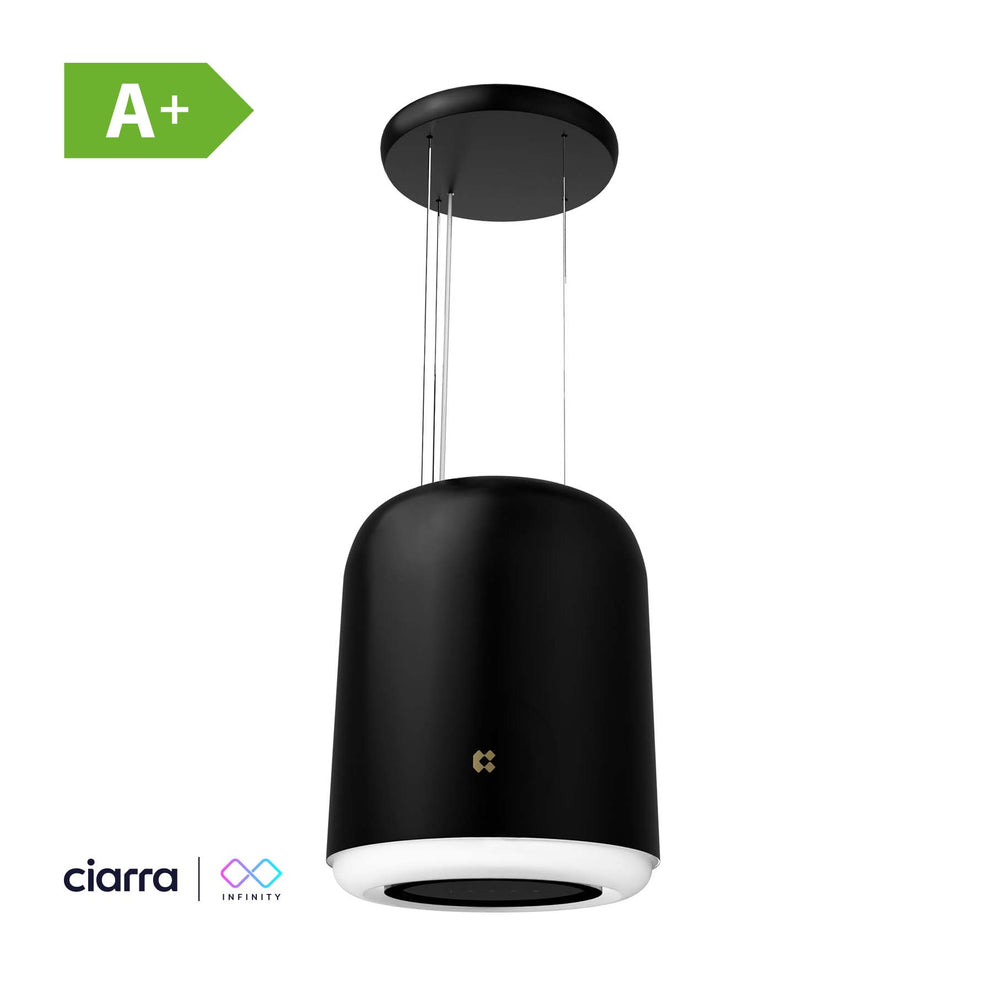
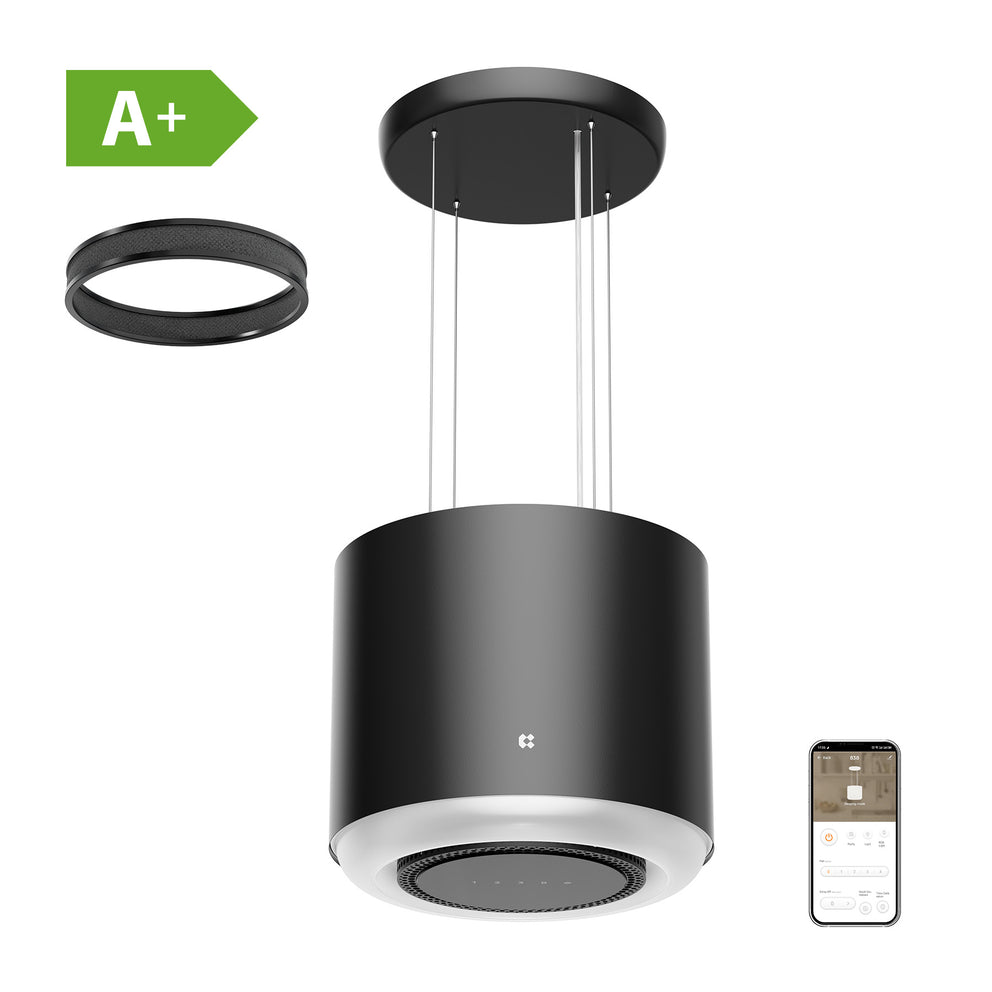
1. CIARRA INFINITY Smart Island Cooker Hood
3-in-1 cooker hood, lamp hood and air purifier
Estimated minimum ceiling height: approximately 204 cm (2.04 m).
Based on an assumed hob height of 90 cm, a clearance of 65 cm and the INFINITY's 49 cm body height, the calculation is 90 + 65 + 49 = 204 cm.
The CIARRA INFINITY combines a cooker hood, decorative lighting and air purification in one distinctive island design. Its customizable outer shell makes it suitable for contemporary kitchens where the cooker hood is intended to be a visual feature as well as a functional appliance.

- 3-in-1 functionality: Combines cooking extraction, ambient lighting and air purification.
-
Plasma⁺ and H13 HEPA filtration: Designed to help treat cooking odours and airborne particles.
- Four power levels: Maximum stated airflow of 550 m³/h.
- Smart controls: Operate the fan and LED ambient light ring through sensor touch controls or the Smart Life app.
-
Recirculation system: Returns filtered air to the kitchen without requiring an external exhaust duct.
- Maintenance: Replace the H13 HEPA filter every 180 days, according to the manufacturer's advice.
- Warranty: 24 months.
Best suited to: Kitchens that need a decorative island hood with integrated air purification, provided the available ceiling height meets the final installation requirements.
2. CIARRA 48 cm Smart Island Cooker Hood CBCB4850-OW
Up to 700 m³/h extraction · €339.99
Estimated minimum ceiling height: approximately 190 cm (1.90 m).
Based on an assumed hob height of 90 cm, a clearance of 65 cm and a body height of 35 cm, the calculation is 90 + 65 + 35 = 190 cm.
With its compact 35 cm-high body, this model has a lower theoretical height requirement than the INFINITY. It also offers a higher stated maximum extraction rate, making it worth considering for open-plan kitchens where cooking odours need to be managed efficiently.

- Powerful extraction: Maximum stated airflow of 700 m³/h across four power levels.
- Energy-efficient DC motor: Designed to provide strong extraction while reducing energy consumption.
- Recirculation and carbon filtration: Helps reduce cooking odours without external ducting.
- UV air-purification function: The manufacturer states that the technology helps break down grease deposits; the UV light switches off automatically when the aluminium filter is removed.
- Smart Life app: Control fan speeds, lighting and the air-purification function through the app.
- Two-level dimmable LED lighting: Adjust the lighting to suit your kitchen.
- Maintenance: Replace the carbon filter every 2–4 months, as advised by the manufacturer.
- Warranty: 24 months.
Best suited to: Lower-ceiling kitchens that need a compact island hood with a high stated airflow capacity and smart controls.
3. CIARRA 41 cm Smart Island Cooker Hood CBCB4838-OW
Up to 550 m³/h extraction · €409.00
Estimated minimum ceiling height: approximately 190 cm (1.90 m).
Using the same assumptions, the calculation is 90 cm hob height + 65 cm clearance + 35 cm body height = 190 cm.
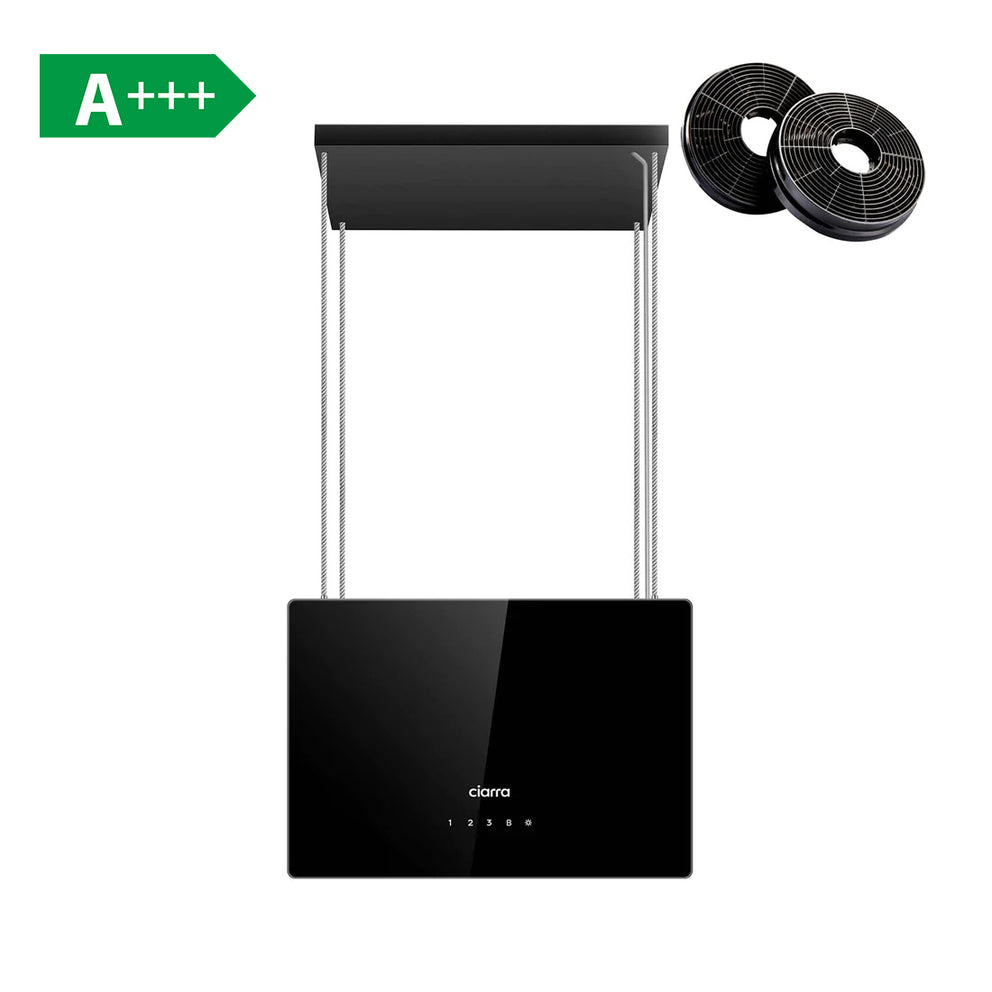
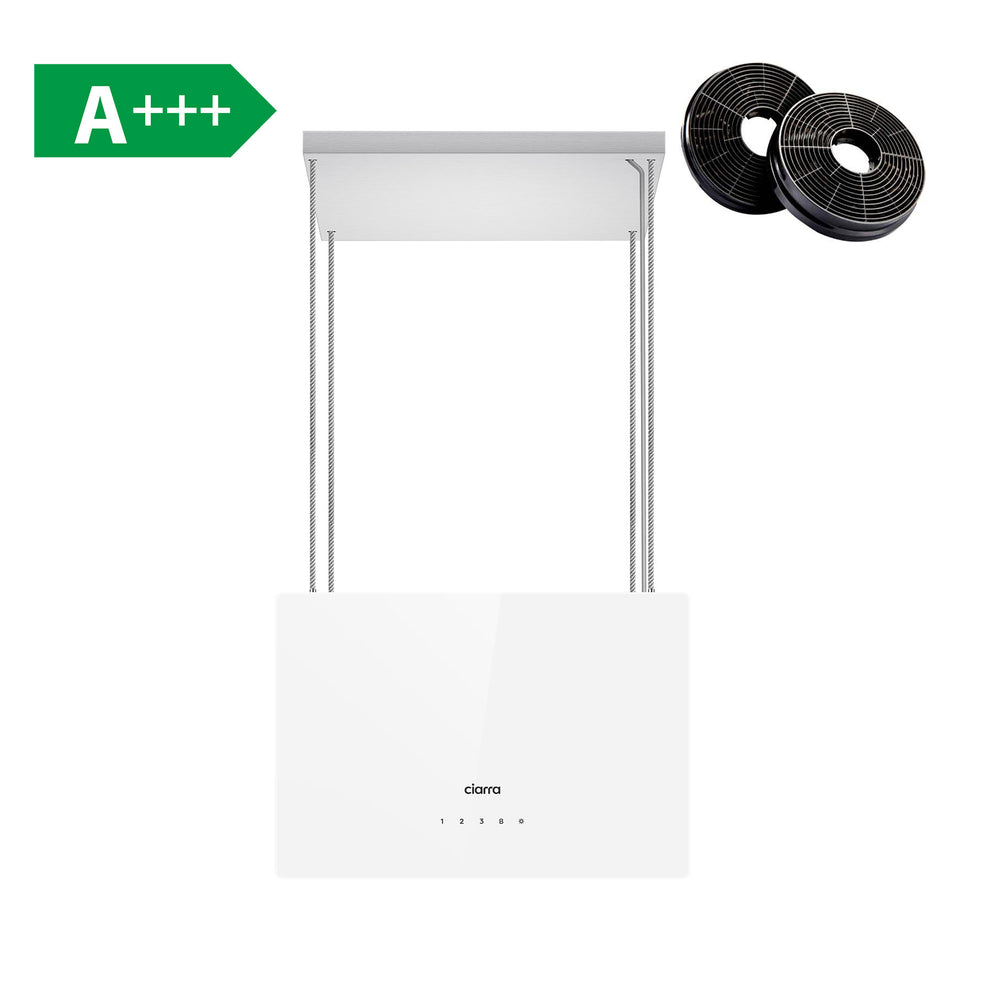
The CIARRA 41 cm Smart Island Cooker Hood features a compact black body suspended from the ceiling by adjustable steel cables. Its streamlined design and recirculation system make it an option for smaller kitchens or island layouts where external ducting is difficult to install.

- Compact design: A 41 cm-wide body helps maintain an uncluttered look above the island.
- Four power levels: Maximum stated airflow of 550 m³/h.
- Recirculation system: Includes an activated carbon filter to help reduce cooking odours.
- Smart Wi-Fi control: Manage the fan and LED lighting through the Smart Life app or sensor touch controls.
- Adjustable suspension: Steel cables allow the hanging height to be adjusted, subject to the manufacturer's installation requirements.
- Easy maintenance: The aluminium grease filter and carbon filter are accessible for cleaning and replacement.
- Energy efficiency: The supplied specifications state an A+ energy efficiency rating.
- Maintenance: Replace the carbon filter every 2–4 months, according to the manufacturer's advice.
- Warranty: 24 months.
Best suited to: Compact kitchens where a decorative island hood, smart controls and recirculating extraction are priorities.
Minimum Ceiling Height Comparison
|
CIARRA model |
Hood body height |
Assumed hob height |
Clearance |
Estimated ceiling height |
|---|---|---|---|---|
|
INFINITY |
49 cm |
90 cm |
65 cm |
204 cm |
|
48 cm CBCB4850-OW |
35 cm |
90 cm |
65 cm |
190 cm |
|
41 cm CBCB4838-OW |
35 cm |
90 cm |
65 cm |
190 cm |
Important: These figures are theoretical estimates, not confirmed minimum installation heights. The supplied specifications list an adjustable installation height of 100–2,000 mm, but do not clearly define its measurement reference points. Ceiling brackets, suspension geometry and the manufacturer's approved mounting requirements may increase the actual minimum ceiling height. Confirm the installation drawing before treating these estimates as definitive product claims.
FAQs
Can I Install a Normal Island Hood Under a Low Ceiling?
Usually no. Conventional chimney island hoods assume a taller ceiling: a vented unit with a gas hob needs a minimum ceiling height of 7 ft 11 in (2.41 m) per Ciarra's specification. Below that, use a slimline, ceiling-integrated or downdraft design.
What is the Minimum Height for an Island Cooker Hood Above a Hob?
750 mm above a gas hob and a 650 mm minimum above an electric or induction hob in the UK and EU. In North America the equivalent figures are 27 in (68.6 cm) for gas and 24 in (61 cm) for electric, with 36 in (91.4 cm) as a suggested maximum.
Are Ceiling Extractors Good for Low Ceilings?
Yes — low ceilings work in a ceiling extractor's favour, because the shorter distance to the hob improves capture. The limiting factor is the 200–400 mm ceiling void required for the unit and ducting.
Can I Use a Recirculating Island Hood Instead?
Yes, and it avoids running ducting through a shallow ceiling. Be aware that recirculation removes odours but not moisture or heat, so the room still needs ventilation and carbon filters need replacing every 6–12 months.
Will a Low-ceiling Island Hood Hit My Head?
Not if it is installed to specification. A correctly installed hood sits 750 mm (gas) or 650 mm plus (electric) above the hob, which is above head height for the person cooking. Headroom problems come from hoods installed below the minimum, not from low ceilings themselves.
How Much Does a Low-ceiling Island Hood Cost?
Quality slimline and low-profile island hoods sit roughly in the $700–$1,200 / £600–£1,000 band, with specialist designer and flush ceiling units (for example, recirculating 110 cm models) reaching £3,000. Budget separately for installation: suspended island hoods need structural fixing to joists or blocking, sealed metal ducting, and typically a dedicated circuit.
Does a Low Ceiling Affect Extraction Performance?
It can improve it. A shorter distance between hob and hood means fumes have less time to disperse before capture, which is why ceiling hoods often perform better in low rooms than in high ones.
News

Sustaining Quality, Elevating Kitchens: The CIARRA Story So Far

From IFA to KBIS: Ciarra’s Global Expansion and 8-Year Milestone


Comments
There are no comments yet.