An island hood sits above the worktop and pulls cooking fumes upwards. A downdraft extractor sits behind or inside the hob and pulls them sideways and down.
If you fry, sear, use a gas hob, or cook for a family most days, an island hood wins on performance — it works with rising heat instead of against it. If you cook lighter meals on induction, want an uninterrupted view across an open-plan room, or your ceiling makes overhead ducting impossible, a downdraft is the better fit.
Island Hood vs Downdraft: How Each System Actually Works
An island hood and a downdraft extractor remove cooking fumes in different ways. An island hood captures steam, grease and odours as they rise from the hob, while a downdraft extractor draws cooking fumes downwards or sideways towards an extraction inlet positioned near the cooking surface.
How Does an Island Hood Work?
An island hood is mounted above a kitchen island, directly over the hob. When you cook, the hood's fan draws rising steam, grease particles and cooking odours into the extraction system.
The air then follows one of two routes:
-
Ducted extraction: Cooking air passes through grease filters before being carried outside through ductwork. This helps remove airborne grease, odours and moisture from the kitchen.
-
Recirculating extraction: Air passes through grease filters and, where fitted, charcoal or other odour filters before being returned to the kitchen. This helps reduce cooking smells but does not remove moisture outdoors.
Because an island hood is positioned above the cooking area, it can capture rising fumes before they spread throughout an open-plan kitchen. Its effectiveness depends on the hood's width, extraction rate, installation height, and how well its capture area covers the hob.

How Does a Downdraft Extractor Work?
A downdraft extractor uses a fan to draw cooking fumes towards an inlet located at the back or side of the hob, or integrated into the cooking surface itself. Some models rise from the worktop when switched on and retract when not in use, while integrated hob extractors remain built into the worktop.
Downdraft systems are particularly appealing in modern European kitchens where homeowners want an unobstructed view across the island without a suspended cooker hood. The key difference is the direction in which each system captures cooking fumes. An island hood works with the natural upward movement of hot air, while a downdraft extractor draws fumes towards an inlet closer to the hob.
For frequent frying, searing or high-heat cooking, an appropriately sized island hood may offer more straightforward capture of rising fumes.

Which is Better, Downdraft or Updraft?
Updraft extraction is generally better for capturing cooking fumes, as an updraft cooker hood draws steam, grease and odours upwards as they naturally rise from the hob. It is particularly suitable for frequent frying, high-heat cooking and open-plan kitchens.
Downdraft extraction is a good alternative for modern kitchens where an unobstructed view is a priority. However, it must draw fumes downwards or sideways, so its effectiveness depends on the extractor's design, airflow and installation.
Which should you choose? Choose an updraft island hood for straightforward, effective extraction in most kitchen layouts. Choose a downdraft extractor if you prefer a minimalist design and want to keep the space above your kitchen island clear.
Island Hood vs Downdraft: Head-to-Head Comparison
|
Factor |
Island hood (overhead) |
Downdraft extractor |
|
Airflow direction |
Upwards, with the thermal plume |
Horizontally, then down — against the plume |
|
Capture efficiency |
High. Canopy acts as a reservoir |
Moderate. Relies on proximity plus motor power |
|
Best cooking style |
Frying, searing, wok, gas hobs, batch cooking |
Light to moderate cooking, induction, quick meals |
|
Tall stockpots & steam |
Captured |
Steam often escapes above the intake |
|
Sightlines across the room |
Interrupted — becomes a focal point |
Clear. Nothing above the worktop when retracted |
|
Headroom |
Needs correct clearance above the hob (commonly 65–75 cm) |
Full headroom — the only real option for very low ceilings |
|
Base cabinet storage |
Fully available |
Motor and ducting consume the cabinet below the hob |
|
Ceiling work needed |
Structural fixing + duct route through the ceiling void; joist direction matters |
None in the ceiling — but ducting must go down and out |
|
Typical extraction (EU models) |
600–1,200+ m³/h |
570–850 m³/h |
|
Noise |
Depends on motor and duct design; remote blowers help |
Motor close to the cook, worktop acts as a sounding board, but rarely runs at maximum because it sits so close to the hob |
|
Gas hob compatibility |
Fully compatible |
Airflow can deflect flames; needs careful positioning and sometimes a higher burner setting |
|
Worktop impact |
None |
Large cut-out required — effectively irreversible in stone or ceramic |
|
Typical purchase price (UK/IE) |
£500 budget to £3,000+ premium |
£1,000 to £2,500+ |
|
Ongoing cost |
Grease filters; carbon filters if recirculating (roughly every 6 months) |
Grease filters plus more frequent cleaning; carbon filters if recirculating |
|
EU energy label |
Full A+++ to D range available |
Typically A to C |
Two rows in that table deserve expansion, because they cause most of the post-purchase regret.
1. Gas Hobs: The Downdraft's Real Weakness
A downdraft pulls air horizontally across the hob, and a gas flame is a moving thing. Airflow can push the flame to one side, reduce its output, or in bad cases, extinguish it. On some downdraft models with gas hobs, you have to run a higher burner setting or a lower fan speed to keep the flame stable.
There is also a safety dimension that European installers take seriously. Combustion from a gas hob produces moisture and by-products, and the extraction duct must never share a flue or chimney with a boiler, gas fire or any other gas appliance — a shared flue can pull combustion products back into the kitchen. If you have any open-flame appliance, keep independent background ventilation working regardless of the hood, and fit a carbon monoxide alarm.
2. Tall Pots, Woks and the Plume that Gets Away
A downdraft's intake is at or just above worktop level. Steam leaving the top of a 25 cm stockpot has already risen past it. If your cooking regularly involves tall pots, woks, large pasta pans or a deep fryer, this is the single most common reason people report a downdraft as "not quite enough".
Cooks who get on well with downdrafts tend to adapt without noticing: they keep pans on the rear rings nearest the vent, use lids, drop boiling water to a simmer, and start the extractor before they start cooking. Those habits are also exactly what manufacturers recommend for any hood — Ciarra's buying guide and most European installation manuals advise switching on 5–10 minutes before cooking and leaving it running 5–15 minutes afterwards.
What the EU Energy Label Tells You That Marketing Doesn't
Every domestic range hood sold in the EU carries an energy label and is registered in EPREL, the European Product Registry for Energy Labelling, accessible by scanning the QR code on the label. The label is governed by Delegated Regulation (EU) No 65/2014, with ecodesign requirements in Regulation (EU) No 66/2014. The European Commission's range hoods page summarises what each field means.
The fields that actually discriminate between an island hood and a downdraft:
- Fluid Dynamic Efficiency (FDE) class, A–G — how much air the hood moves per watt. This is the honest measure of motor quality, and it is where premium brands separate from cheap ones.
- Grease Filtering Efficiency class, A–G — how much airborne grease the filter traps. This matters more for downdrafts, because they must pull heavy grease particles sideways against their natural momentum.
- Airborne acoustical sound power (dB) — measured at the highest setting for normal use, excluding boost. Note it is sound power, not the sound pressure you experience in the room, so a lab figure of 64 dB is not the same thing a decibel meter app measures at the worktop.
- Annual Energy Consumption (kWh/year) — based on the standard profile of one hour of extraction and two hours of lighting per day, 365 days a year.

For comparison, a mid-range 90 cm island hood at around £770 typically claims 600 m³/h at an efficiency rating of B, with published figures around 64–68 dB(A). A good downdraft is not automatically the weaker appliance on paper — it is weaker in plume capture, and the label does not measure that at all. Read the airflow and FDE numbers, then sanity-check the system type against how you cook.
All hood performance figures in the EU come from the same test standard, EN IEC 61591, which is why the numbers on a Ciarra, a Bosch, a BORA, and a Faber can be compared at all.
Installation Reality and Real Costs in Europe
Neither option is a plug-in appliance. Which is harder depends on your building, not on the product.
Island hood: the work is above you
Ceiling structure. An island hood has to be fixed securely to the ceiling, which may mean reinforcement, especially for larger canopies.
Duct route. Rigid 150 mm ducting is the standard, and it has to travel through the ceiling void to an outside wall. Squeezing in 120 mm duct to save space costs roughly a quarter of your airflow.
Keep the run short. Trade guidance is to keep the equivalent duct run under about 3 metres, and to treat every 90° bend as adding roughly 1.5 metres of equivalent length. A longer run with more bends is the most common cause of a hood that seems underpowered.
Plan before plasterboard. The duct route and the external opening must go in at first fix. Retrofitting a duct after plastering and tiling is the most expensive ventilation fix there is.
Downdraft: the work is below you
Worktop cut-out. A large, precise cut-out is required. In quartz, granite or ceramic, this is effectively a one-way door — if you later change your mind, replacing the worktop usually costs more than the extractor did.
Cabinet space. The motor block and ducting sit in the cabinet directly under the hob. On some models, this makes the shallow fit extremely tight, and you lose storage you had assumed was yours.
Ducting downwards. Air has to exit downwards, then out. If your island sits over a solid concrete slab, this means trenching. If it sits over a basement or a ventilated void, it is far simpler.
Recirculation is the common configuration. Downdraft extractors are frequently installed in recirculating mode, filtering air through grease and carbon filters and returning it to the kitchen. That avoids the floor ducting problem entirely — but recirculation does not remove moisture. In a modern airtight dwelling, steam has to go somewhere, and a recirculating hood will not solve condensation.
Who Should Buy Which? Six Real Household Profiles
There is no single "best extractor for a kitchen island" — only the one that matches how you cook and how the room above and below you is built. Here is how the decision usually resolves itself.
1. The daily family cook with a gas hob → Island hood.
Multiple pans, high heat, kids in the room, cooking most evenings. The canopy's extra capture volume and the absence of flame interference make this a straightforward win. Get at least 750 m³/h, ideally more.
2. The design-led open-plan minimalist → Downdraft (or ceiling hood).
You knocked through to the living room, the island faces the garden or the sofa, and a stainless steel chimney would ruin the view. If you cook lightly, a high-spec downdraft delivers. If you cook seriously but still want invisible extraction, price the ceiling hood before you commit.
3. Low or awkward ceilings → Downdraft.
Under 2.3 m, an island hood starts to feel intrusive and may not leave a safe clearance above the hob. Vaulted or sloped ceilings complicate mounting and usually need an extension flue or a sloped-ceiling adapter. Downdraft sidesteps all of it.
4. Single-storey extension, flat roof, or a bathroom above → Downdraft.
No ceiling void, no joist direction to work with, no route out. A downdraft is often the only viable option — which is precisely the case it was designed for.
5. Small kitchen or peninsula → Downdraft.
Space is the constraint and a bulky canopy would dominate. A compact 52–60 cm downdraft keeps the room open, and recirculation avoids ducting entirely.
6. Airtight new-build or passive house → Island hood or ceiling hood, ducted.
If the thermal envelope is tight (RT2012, KfW, Passivhaus), you need a hood that removes moisture, not one that filters it and gives it back. Choose a ducted system and plan the make-up air.
What is the Best Downdraft Ventilation System?
The best downdraft ventilation system is one that combines effective extraction, advanced filtration and easy installation. For kitchens where installing external ductwork is difficult, a recirculating downdraft system is a practical choice, as it filters cooking air and returns it to the kitchen, reducing the need for complicated ducting.
For better odour control, look for a system with multiple filtration stages, such as a grease filter, an activated carbon filter and an advanced Plasma⁺ filter. The carbon filter helps reduce cooking smells, while plasma-based filtration provides an additional stage of odour treatment. These features can help maintain fresher indoor air, although performance depends on the specific system and filter design.
A high-quality system should also offer suitable extraction performance, low noise levels, easy-to-clean filters and straightforward maintenance. Before purchasing, check whether the recirculating kit and all required filters are included, as well as the space needed beneath the hob.
For most modern European kitchens, a recirculating downdraft ventilation system with advanced multi-stage filtration, including Plasma⁺ technology where compatible, is worth considering if you want effective odour control without the hassle of installing external ductwork.
If you are looking for the best downdraft ventilation system with advanced filtration, CIARRA offers two innovative cooker hood solutions featuring Plasma⁺ technology. Whether you prefer a multifunctional island cooker hood with air purification or a compact induction hob with an integrated extractor, both options combine modern design with advanced odour treatment to help keep your kitchen air fresher.
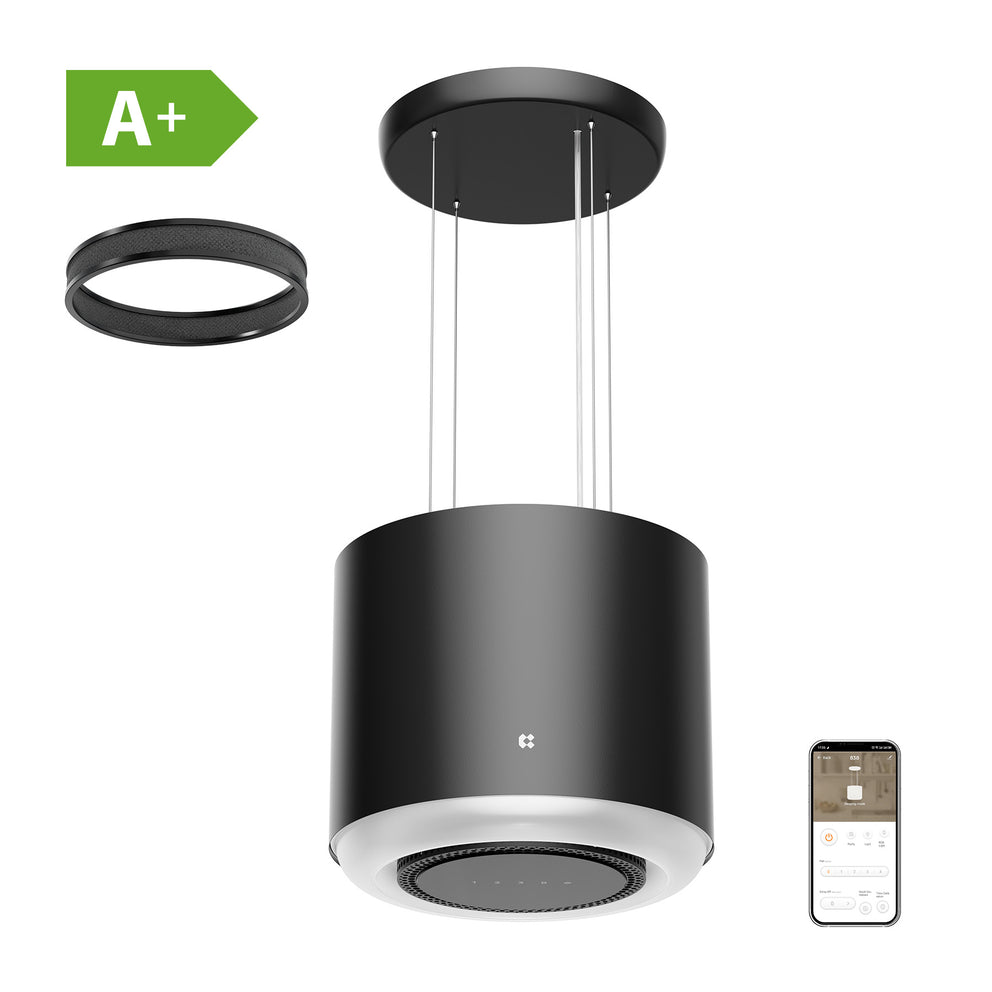
1. CIARRA INFINITY Smart Island Cooker Hood – 3-in-1 Cooker Hood, Lamp Hood & Air Purifier Price: €999.99
The CIARRA INFINITY is an innovative 3-in-1 appliance that combines a cooker hood, decorative lamp and air purifier. Its recirculating design makes it an attractive option for kitchens where installing external ductwork is difficult, while its Plasma⁺ system and H13 HEPA filtration provide multiple stages of air treatment.

Key features:
- Advanced multi-stage filtration: Combines an eight-layer stainless steel grease filter, an H13 HEPA filter and the Plasma⁺ system to help capture grease particles and reduce cooking odours.
- Powerful extraction: Offers a maximum specified extraction rate of up to 550 m³/h.
- Air purification: The H13 HEPA filter is designed to capture up to 99.97% of 0.3-micron particles under specified test conditions.
- Smart control: Adjust the four power levels and RGB ambient lighting using sensor-touch controls or the Smart Life app.
- Customisable design: Personalise the outer shell to complement your kitchen interior.
- Easy maintenance: The stainless steel grease filter is dishwasher-safe. The H13 HEPA filter should be replaced every 180 days, according to the manufacturer's advice.
The CIARRA INFINITY is particularly suitable for homeowners who want more than conventional cooking extraction. Its combination of Plasma⁺ technology, HEPA filtration and recirculating operation offers an integrated solution for cooking odours and airborne particles without requiring a conventional external exhaust duct.
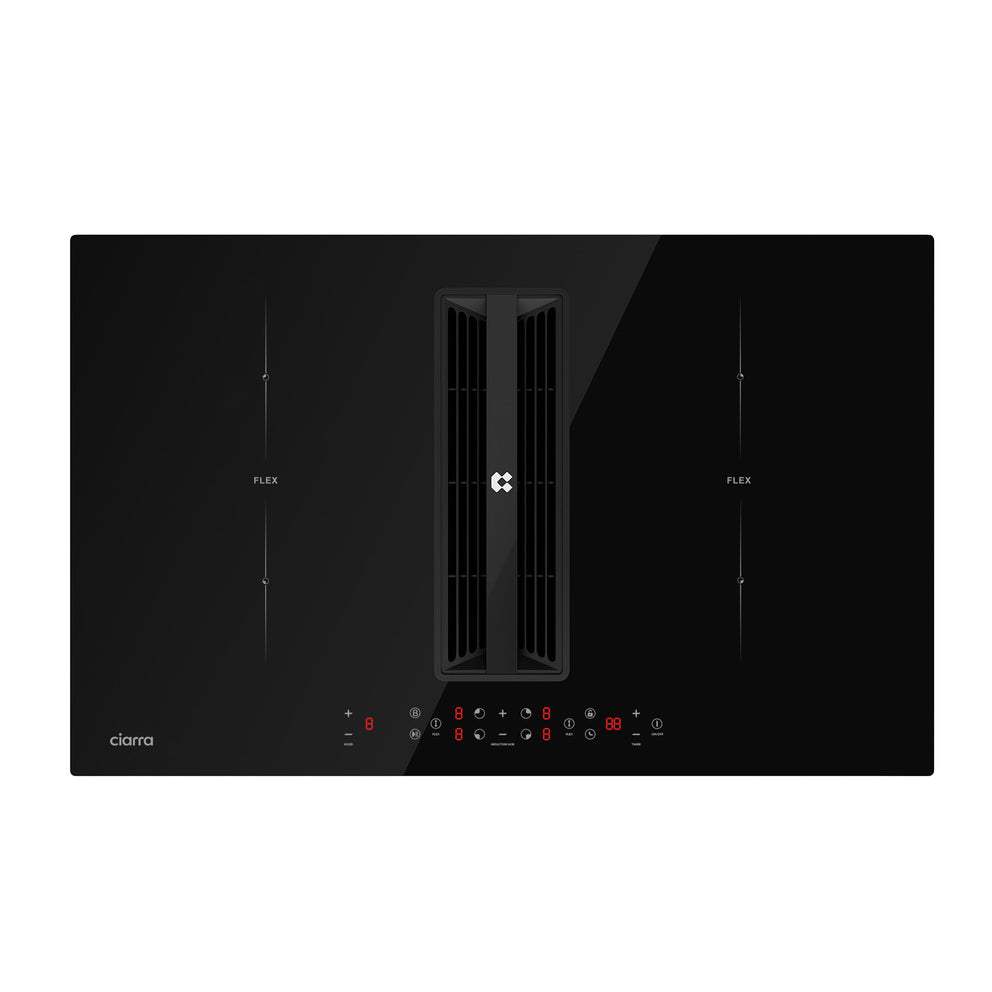
2. CIARRA ONE 390mm Compact Domino Induction Venting Extractor Hob – Built-In Plasma⁺ System Price: €1,389.99
For kitchens where worktop space and an unobstructed view are priorities, the CIARRA ONE combines an induction hob and extractor in a single compact appliance. Its built-in Plasma⁺ system treats cooking odours close to their source, eliminating the need for a traditional overhead cooker hood.

Key features:
- Integrated Plasma⁺ filtration: Uses high-voltage plasma technology, UV-C treatment and a honeycomb filter designed to help treat odours and reduce residual ozone.
- Compact design: The 390 mm-wide domino induction hob is suitable for smaller kitchens, kitchen islands and space-conscious layouts.
- Efficient extraction: Provides multiple extraction settings, with a maximum airflow of up to 505 m³/h according to the product specifications.
- Powerful induction cooking: Delivers up to 3,200 W, with nine power levels and a booster function.
- Flexible kitchen design: Keeps the space above the hob clear, preserving sightlines in open-plan kitchens.
- Reduced filter replacement requirements: The integrated Plasma⁺ system is designed to reduce the need for conventional odour-filter replacements, helping lower ongoing maintenance costs.
The CIARRA ONE is an excellent option for homeowners seeking an integrated downdraft-style extraction solution with advanced odour treatment. By combining induction cooking and Plasma⁺ extraction in one appliance, it helps create a cleaner, more streamlined kitchen without a bulky overhead hood.
FAQs
Can a Downdraft Extractor Handle Frying and High-heat cooking?
It can handle it, but it works harder for it. Frying and searing generate the most airborne grease and the fastest-rising smoke, which is exactly what a low-mounted intake is worst at capturing. If you fry regularly, treat a downdraft as a compromise and choose a high-specification model.
How Much Does a Downdraft Extractor Cost in Europe?
Expect roughly £1,000–£1,995 for a telescopic downdraft and £2,300–£3,000+ for a hob with integrated extraction. Installation is the bigger variable: downward ducting through a solid floor, or a worktop cut-out in stone, can add substantial cost. A comparable island hood typically starts around £500.
Can I Fit a Downdraft Into an Existing Kitchen with a Stone Worktop?
Technically yes, practically rarely. It requires a large precision cut-out in the worktop and loss of the cabinet beneath the hob, plus somewhere for the ducting to go. In quartz, granite or ceramic, the cut-out is irreversible, so most installers advise doing it only as part of a full kitchen change.
Which is Better for a Low Ceiling?
A downdraft. It needs no overhead clearance at all, whereas an island hood must maintain its minimum distance above the hob and can feel oppressive in a room under about 2.3 m. A flush ceiling hood is the compromise if you want overhead performance in a low but still generous space.
Conclusion
An island hood and a downdraft extractor are not competitors on performance. They are optimised for different things, and the marketing rarely admits it.
The island hood is engineered around physics. It is the correct answer for anyone who cooks seriously, uses gas, or produces a lot of grease and steam — and its visible presence is the price of that performance.
The downdraft is engineered around architecture. It is the correct answer for open-plan living, low ceilings, awkward roof structures and a kitchen island without an overhead hood. Its limitation is not quality — premium examples carry A+ energy ratings, class A grease filtering and sub-45 dB minimum speeds — it is that capturing a rising plume from below is genuinely hard.
News

Sustaining Quality, Elevating Kitchens: The CIARRA Story So Far

From IFA to KBIS: Ciarra’s Global Expansion and 8-Year Milestone



Comments
There are no comments yet.