What is a 60cm Telescopic Cooker Hood?
A telescopic cooker hood, 60 cm wide, is a pull-out extractor that hides inside the wall cabinet above your hob and slides forward only while you cook.
When retracted, it sits flush with the cabinet base; when extended, its front panel reaches out over the front burners. For a European kitchen with a standard 600mm cabinet run, it is usually the only extraction option that costs you zero visible space.
The numbers that matter: the appliance body is normally 598mm wide, 175–205mm tall and 290–320mm deep, extending to roughly 450–460mm when pulled out. Expect 250–400 m³/h of airflow in normal use, 60–65 dB(A) at maximum speed, and 20–40 kWh/year on the EU energy label.
Getting these five figures right is the difference between a hood that disappears into your cabinetry and one that arrives undrillable.
Below is how to check each one before you buy, in the order European buyers actually need them.
What "telescopic" Really Means (and How It Differs from Other 60cm Hoods)
Telescopic, pull-out, and slide-out all describe the same mechanism: a flat chassis fixed under or inside a wall cabinet, with a drawer-like visor that extends horizontally.
-
Telescopic / pull-out — retracts completely; the visor becomes the front panel. Best for keeping a continuous cabinet line.
-
Visor / slimline — a fixed, slightly angled glass or steel panel. Cheaper, but always visible and always in your eyeline.
-
Canopy/ built-in — hidden inside the cabinet with only a slim edge showing; needs more cabinet height and a proper chimney or duct route.
The practical difference is headroom. A telescopic hood adds only 17–20cm below the cabinet, and nothing at all when closed, which is why it survives in kitchens where a 60cm canopy would leave you ducking over the pans.
One trade-off to accept up front: because the motor sits in a shallow chassis, telescopic models rarely match the raw airflow of a full-size chimney hood.
Are 60cm Telescopic Hoods Good?
Yes, 60cm telescopic cooker hoods are a good choice for small kitchens, apartments and compact cabinet spaces. They offer space-saving installation, adjustable extraction and discreet storage when not in use. For the best results, choose a model with sufficient airflow for your kitchen, check that the extended visor covers the front hob rings, and ensure the ducted or recirculating installation suits your home.
How to Choose the Telescopic Cooker Hood 60cm?
1. Nominal vs Actual Width
A "60cm" hood is matched to a 600mm cabinet, but the appliance itself is almost always 598 or 599mm — deliberately 1-2mm narrower so it slides into the carcass without binding.
Check: is your cabinet run a true 600mm, or a 500/550mm unit? A 60cm hood will not fit a 50cm cabinet, and a 90cm hob with a 60cm hood will leave the outer rings uncovered.

2. Chassis Height and the "niche"
Chassis height runs 175–205mm. That height has to come from somewhere:
- Under-mount — the hood hangs below the cabinet base. Easiest retrofit, but you lose ~18cm of clearance above the hob.
- In-cabinet — the cabinet base is cut and the hood is recessed into it.
Check: the internal height of your wall cabinet. Standard European wall units are 720mm tall with a 300–350mm depth — usually fine — but a cabinet with a mid shelf or a drawer box at the bottom will not accept an in-cabinet install.

3. Depth, and how far it reaches when extended
Body depth is 290–320mm, matched to a standard 300–350mm wall cabinet. The visor adds roughly 110–170mm, so a fully extended hood reaches about 400–460mm.
Check: measure from the wall to the front edge of your front hob ring. If that distance exceeds the extended depth (≈400mm), the front burners sit outside the capture zone — the single biggest cause of "the hood doesn't work" complaints on compact models.

4. Ducted or recirculating? The decision most European flats are forced into
If you live in an apartment without a facade duct, common in older city buildings and in rented flats where core drilling is not permitted — recirculation is not a compromise; it is the only legal option.
How each mode works
-
Ducted (extraction): grease and odour-laden air is pushed outside through a 120mm or 150mm duct. 150mm flows better; 120mm is more common on compact telescopic bodies. A non-return flap prevents backdraught.
- Recirculating (filtering): air passes through the aluminium grease filter, then an activated carbon filter, then back into the room. Grease and smoke particles are captured; odours are adsorbed.
What to verify before ordering
1. Is the model convertible at all? Many are, but the recirculation kit is a separate accessory. Budget €25–60 on top of the hood.
2. Is the carbon filter easy to buy in your country? Check for a local SKU, not just a listing on a marketplace. Telescopic carbon filters are model-specific pads or cassettes, and a discontinued pad effectively ends the hood's life.
3. How often do you replace it? Manufacturer guidance is typically every 3–6 months for regular cooking; heavy frying shortens that. Add the yearly cost to the purchase price when comparing.
4. Is the grease filter dishwasher-safe? On almost all 60cm telescopic models it is — aluminium cassettes, usually two, lifting out without tools. Hand-washing in hot degreaser monthly is the fallback.
5. Airflow, noise and the EU energy label
How much airflow you actually need
European homes generally want 300–600 m³/h for serious cooking. Telescopic hoods sit at the lower end of that range because of their shallow chassis:
|
Model type |
Normal max |
Boost / intensive |
|
Compact / budget |
250–280 m³/h |
— |
|
Mid-range |
350–400 m³/h |
400–550 m³/h |
|
High-output telescopic |
500–550 m³/h |
— |
A rough sizing rule: 10 × kitchen volume (m³) for an enclosed kitchen, and add 20–30% for open-plan. A 4 × 3 × 2.5m kitchen is 30m³, so ~300 m³/h plus headroom. Duct diameter matters as much as the motor — a 400 m³/h hood squeezed onto a long 120mm flex duct with two bends will perform like a 250 m³/h one.
6. Reading the dB number correctly
This is the most misread spec on the page. Under EU labelling, noise is declared as A-weighted sound power level, LwA, in dB re 1 pW — measured in a reverberant test room, not at your ear. It is typically 6–10 dB higher than the sound pressure level you perceive standing at the hob. Two consequences:
- A hood quoting "62 dB" may sound closer to 52–56 dB in a real kitchen.
- Comparing a brand that quotes LwA with one that quotes sound pressure at 1m is meaningless.
For a quiet kitchen, target ≤65 dB(A) LwA at maximum normal speed, and check whether there is a boost level that pushes past 70 dB — you will not want to use it for a 40-minute roast.
7. Brands and price bands: how to compare fairly
The 60cm telescopic segment in Europe clusters into three tiers. Prices below are typical street prices including VAT, and move with promotions.
|
Tier |
Price |
Typical players |
What you get |
What you give up |
|
Entry |
€100–200 |
Ciarra, Klarstein, Teka lower lines, own-brand |
250–300 m³/h, 2–3 speeds, slider control, class C–D |
Higher noise, no boost, basic grease filtration |
|
Mid |
€200–400 |
Bosch, Siemens iQ300, Electrolux, Teka |
350–400 m³/h + boost, 3 speeds + intensive, BLDC motor, class A–B, 60–63 dB |
Still 120mm duct on some models |
|
Upper |
€400–600+ |
Siemens iQ500, Bosch Serie 6/8, premium Teka |
500 m³/h+, softer acoustics, better grease class, auto functions |
Diminishing returns in a 6m² kitchen |
6. Controls, automation and DIY replacement
The slide-switch behaviour
On most telescopic hoods the visor is mechanically linked to a slider switch: pull out → motor and LED start; push back → everything stops. On better models the light stays on independently, or the fan runs on a delay. Mechanical sliders are more repairable; soft-touch electronic panels are easier to wipe and enable a filter-saturation reminder.
Replacing an old hood yourself
Replacement is the most common purchase scenario, and it is genuinely a two-hour DIY job if three things line up:
1. The duct hole. Existing 120mm holes are the norm on older installs; if the new hood ships with a 150mm outlet, you need a reducer (usually included) or a new hole. Never downsize a 150mm hood to 120mm and expect the quoted airflow.
2. The mounting points. New hoods rarely match old screw holes. Expect to drill fresh holes into the cabinet base — check there is no wiring or plumbing behind, and that the cabinet base is at least 16mm chipboard, not 8mm hardboard.
3. The electrics. Most models come with a 1.2–1.9m cable and either a moulded plug or bare wires. In the UK a 3-pin plug is standard; in DE/FR/NL a Schuko or a hardwired connection into a fused spur is common. Rated input is typically 70–150W on a 220–240V supply — well within an existing lighting circuit, but a fixed connection must be made by a qualified electrician in most EU countries.
Order of work: isolate the power → remove filters and old hood → clean and check the duct flap → test-fit the new chassis (do not drill yet) → mark holes → drill → fix → connect duct → connect power → run for 10 minutes and check for vibration against the cabinet.
And you can check the video.
The Best Ciarra 60cm Telescopic Cooker Hood
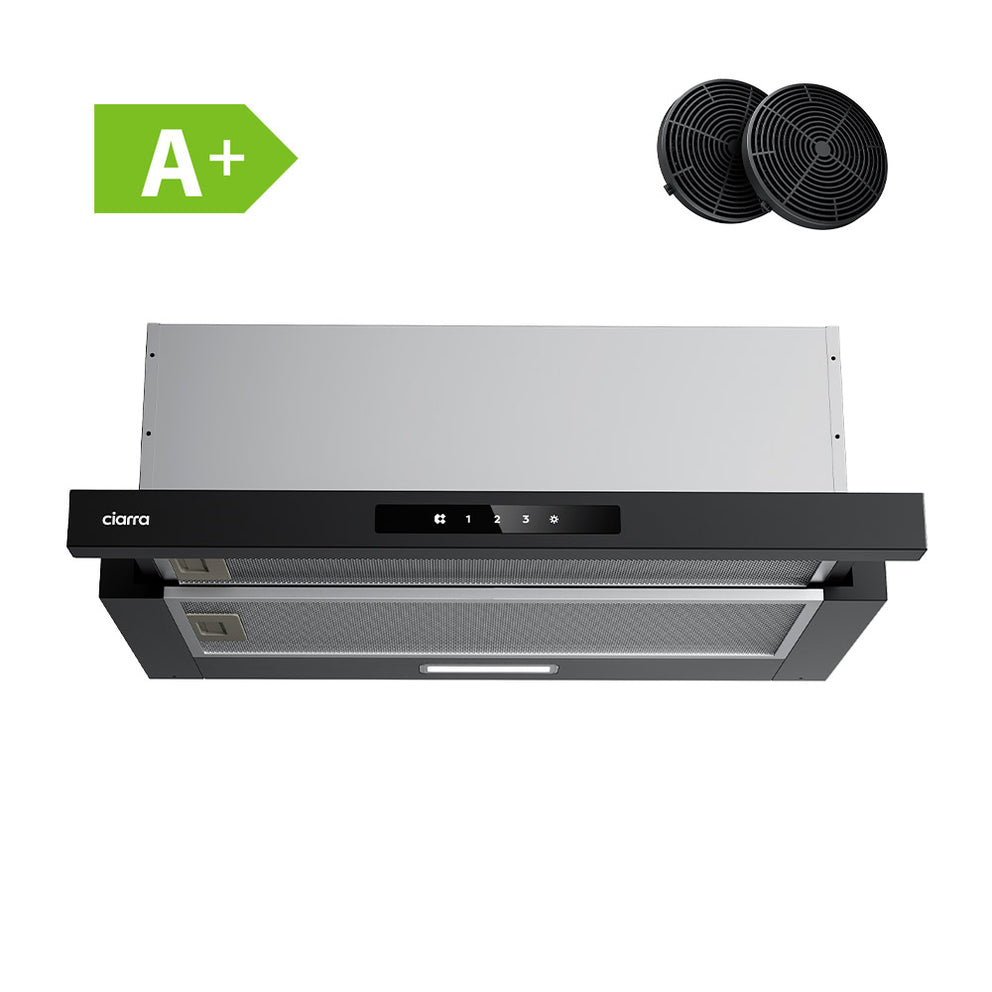
1. CIARRA 60cm Integrated Telescopic Cooker Hood CBCS6909A-OW
€189.99 · A+ energy rating · Touch control · 3 speed levels
The CIARRA CBCS6909A-OW is a 60cm integrated telescopic cooker hood with a nominal width of 60cm and an actual width of 599mm, it is designed to fit a standard 600mm cabinet opening, subject to checking the manufacturer's installation clearances.

Key features and benefits:
1. Compact dimensions and flexible installation
Measuring 599mm wide, 298–453mm deep and 200mm high, this telescopic cooker hood fits neatly into a compatible kitchen cabinet. Its extendable visor increases the depth from approximately 298mm to 453mm, helping bring the extraction area closer to the front cooking zones when pulled out. Before installation, check the cabinet's internal dimensions, the position of any shelves and the distance between the hob and hood.
2. Powerful three-speed extraction
With three extraction levels, the CBCS6909A-OW provides flexibility for different cooking tasks, from light simmering to frying and more intensive cooking. The maximum airflow of 551m³/h makes this model a strong option for a compact telescopic cooker hood. For a typical enclosed kitchen measuring 4 × 3 × 2.5m, with a volume of 30m³, around 300m³/h provides a useful starting point for ventilation planning.

3. Ducted and recirculating operation
This model supports two extraction modes, making it suitable for different kitchen layouts. 2 power levels, incl. activated carbon filter
4. Noise levels for everyday cooking
The CBCS6909A-OW has a stated maximum sound power level of 64dB(A), with lower settings rated at 54dB(A) and 59dB(A). This gives users the option of choosing a quieter setting for everyday cooking and increasing the extraction rate when needed.
5. Energy efficiency and running costs
With an A+ energy efficiency rating, an 86W total rated power and an 85W motor, this model is designed to provide strong extraction without requiring a high-powered motor. Its 1W LED light provides illumination over the hob while keeping lighting power consumption low.
6. Touch controls, lighting and maintenance
The sensor touch control panel provides a modern alternative to traditional rocker switches, allowing users to select their preferred extraction speed. Soft LED lighting illuminates the cooking area, while the extendable visor helps keep the appliance discreet when not in use.
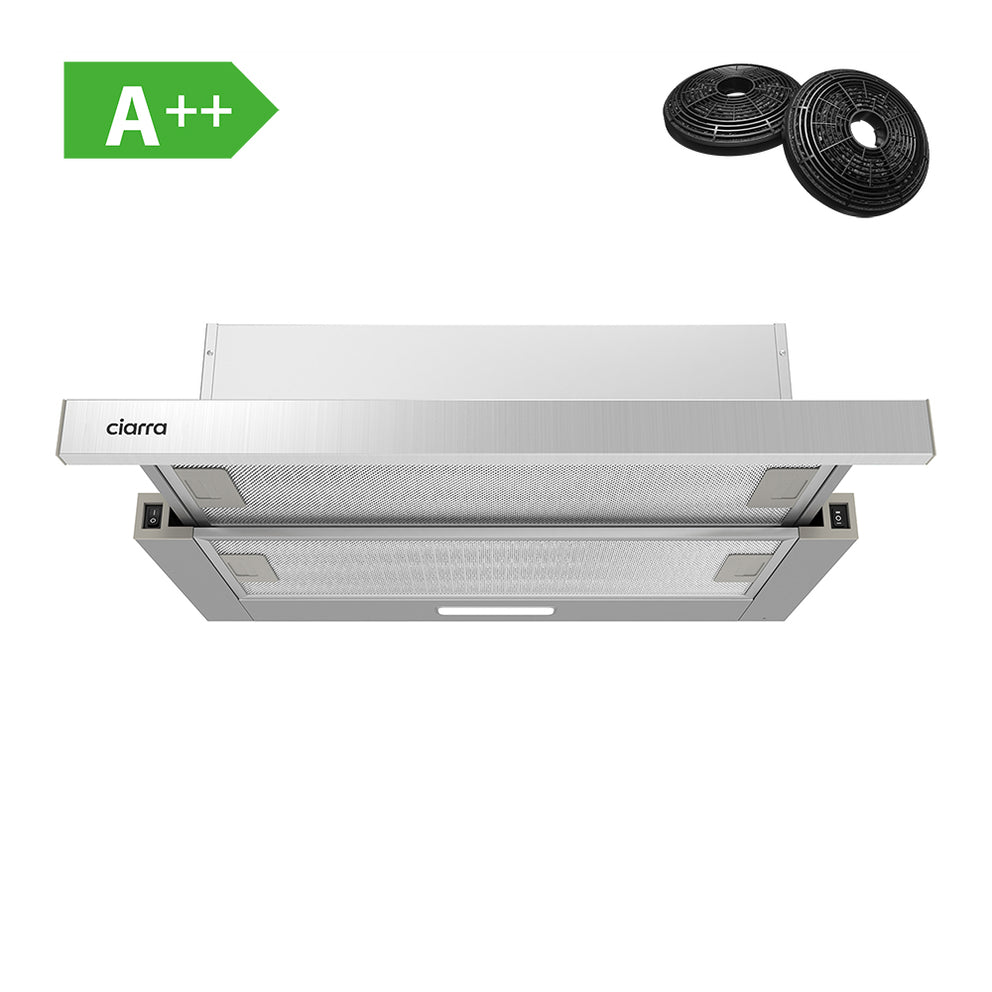
2. CIARRA 60cm Integrated Telescopic Cooker Hood CBCS6906D-OW
€159.99 · A++ energy rating · Rocker controls · 2 speed levels
The CIARRA CBCS6906D-OW is an affordable 60cm integrated telescopic cooker hood designed for everyday cooking in compact kitchens. With a width of 599mm, a slim 200mm chassis and a pull-out visor extending the depth to 453mm, it fits a similar installation footprint to the CBCS6909A-OW.

Key features and benefits
1. Space-saving dimensions and installation options
The CBCS6906D-OW measures 599mm wide, 298–453mm deep and 200mm high. Its compact chassis is designed for integration into a compatible kitchen cabinet, while the extendable visor increases the effective depth when cooking.
The product supports two installation configurations: under-cabinet installation with top ventilation or wall-mounted installation with rear ventilation, subject to the manufacturer's installation instructions and the available outlet position.
2. Two-speed extraction for everyday cooking
The CBCS6906D-OW offers two extraction levels, making it suitable for households that prefer simple controls and straightforward operation.
With a maximum airflow of 355m³/h, this model is suited to light and moderate everyday cooking in smaller enclosed kitchens, depending on the cooking method and ventilation requirements. The lower setting operates at a stated 49dB(A), while the higher setting provides greater extraction for frying and steaming.
3. Ducted or recirculating ventilation
This cooker hood supports both ducted extraction and recirculating operation.
- Ducted mode: Air containing grease, smoke and cooking odours is extracted outside through a compatible outlet. The installation must provide a suitable duct route and diameter.
- Recirculating mode: Air passes through the grease filters and an activated carbon filter before returning to the room. This option is useful in flats and rented properties where external ducting is not practical.
The model includes an activated carbon filter according to the supplied product information. Replacement filters should be changed every 2–4 months, depending on usage. Before ordering replacement filters, confirm their compatibility with the exact CBCS6906D model and their availability in your country.
4. Simple rocker controls and automatic activation
Unlike touch-controlled models, the CBCS6906D-OW uses two rocker switches on either side of the hood to control the two fan speeds and LED lighting. Pulling out the telescopic drawer automatically switches the cooker hood on, making everyday operation simple and convenient.
This mechanically operated design is well suited to buyers who prefer physical switches over electronic touch panels. Its compact construction, removable filters and straightforward controls also make routine maintenance easier.
When a 60cm Telescopic Hood is the Wrong Choice
Being honest here saves everyone a return:
- You have a 90cm hob or a range cooker. A 60cm hood will not cover it; look at 90cm visor or chimney models.
- You cook with a wok or deep-fry weekly. You need 500 m³/h+ and a deeper capture area; a canopy hood with a 150mm duct is a better fit.
- Open-plan kitchen-living space. Recirculation will not keep up with odour over a 40m² room; ducted extraction with a higher airflow is the realistic answer.
- You have no cabinet above the hob — for example a window or a single-storey extension with a vaulted ceiling. A ceiling-mounted or island hood is the correct typology.
Choose the CIARRA CBCS6909A-OW if extraction power is your priority. Its maximum airflow of 551m³/h, three speed settings and touch controls make it the stronger choice for households that cook frequently or need more flexibility when dealing with smoke and cooking odours.
Choose the CIARRA CBCS6906D-OW if you want a more affordable telescopic cooker hood for everyday cooking. It costs €30 less, carries an A++ energy rating and offers simple rocker controls, automatic activation and removable aluminium grease filters.
Both models have a similar physical footprint, so cabinet compatibility and extended visor depth are important checks whichever you choose. If your kitchen has limited ventilation options, confirm the recirculation configuration and replacement carbon filter availability before placing your order.
FAQ
What is the difference between a telescopic and a pull-out cooker hood?
Nothing structural — both names describe the same slide-out mechanism. "Telescopic" is the term used in UK and German retail listings; "pull-out" is more common in French and Italian listings.
Is a 60cm telescopic hood wide enough for a 60cm hob?
Yes, when the hood is centred and the hob is a standard 60cm four-zone unit. It becomes marginal with a 60cm hob that has wide front burners, because the extended visor reaches ~410mm and the outer edge of the front ring may fall outside it.
How deep does the cabinet above my hob need to be?
At least 300mm of internal depth for most chassis, and 350mm if you want the duct to turn behind the cabinet rather than run straight up. Standard European wall units at 300–350mm are usually fine.
Can I use a telescopic hood without an outside wall?
Yes — with a recirculation kit and an activated carbon filter. Expect to replace the carbon filter every 3–6 months, and accept that it controls grease and odour but not humidity.
How noisy is a 60cm telescopic hood in real life?
Declared noise at maximum normal speed is typically 60–65 dB(A) LwA, which corresponds to roughly 52–58 dB(A) perceived at the hob. It is a normal conversation-level hum; a boost setting will be noticeably louder.
Do telescopic hoods come with a plug?
Usually yes in the UK (moulded 3-pin plug) and often bare cable in continental Europe, with a cable length of 1.2–1.9m. Check before ordering if you are replacing a hardwired unit.
Can the grease filter go in the dishwasher?
On nearly all aluminium cassette filters, yes — top rack, 50–60°C, no rinse aid. Wash monthly if you fry often; a clogged filter cuts airflow far more than most people realise.
What energy class should I aim for?
A or A+ if the price gap is small; class B or C is acceptable on a compact hood used for light cooking. Compare annual kWh, not just the letter — the spread across classes on 60cm hoods is only about 15–20 kWh/year.
Conclusion
A telescopic cooker hood 60cm wide is the right answer for a compact European kitchen when three conditions hold: the cabinet run is a true 600mm, the wall-to-front-ring distance is within ~450mm, and you have either a usable duct or a realistic plan for carbon filters.
Buy in this order of priority — fit, then noise, then airflow, then energy class, then price. Fit is the only one you cannot fix later. And when you compare models, insist on four published numbers: width in millimetres, extended depth, dB(A) at maximum normal speed, and duct diameter.
Next step: measure your cabinet, note your duct diameter and clearance, then compare 60cm telescopic models filtered by those three figures — not by the headline airflow on the box.
News

Sustaining Quality, Elevating Kitchens: The CIARRA Story So Far

From IFA to KBIS: Ciarra’s Global Expansion and 8-Year Milestone


Comments
There are no comments yet.