Are you looking for a compact, practical, and affordable cooker hood for your kitchen? A visor cooker hood is an interesting solution, especially for small kitchens, flats, and spaces where installing a traditional decorative hood is not suitable. But how do you choose the right model based on extraction rate, noise level, and filtration type? Discover everything you need to know about visor cooker hoods: how they work, their efficiency, which filters to choose, maintenance tips, and installation rules to enjoy a more pleasant kitchen every day.
What is a Visor Cooker Hood?
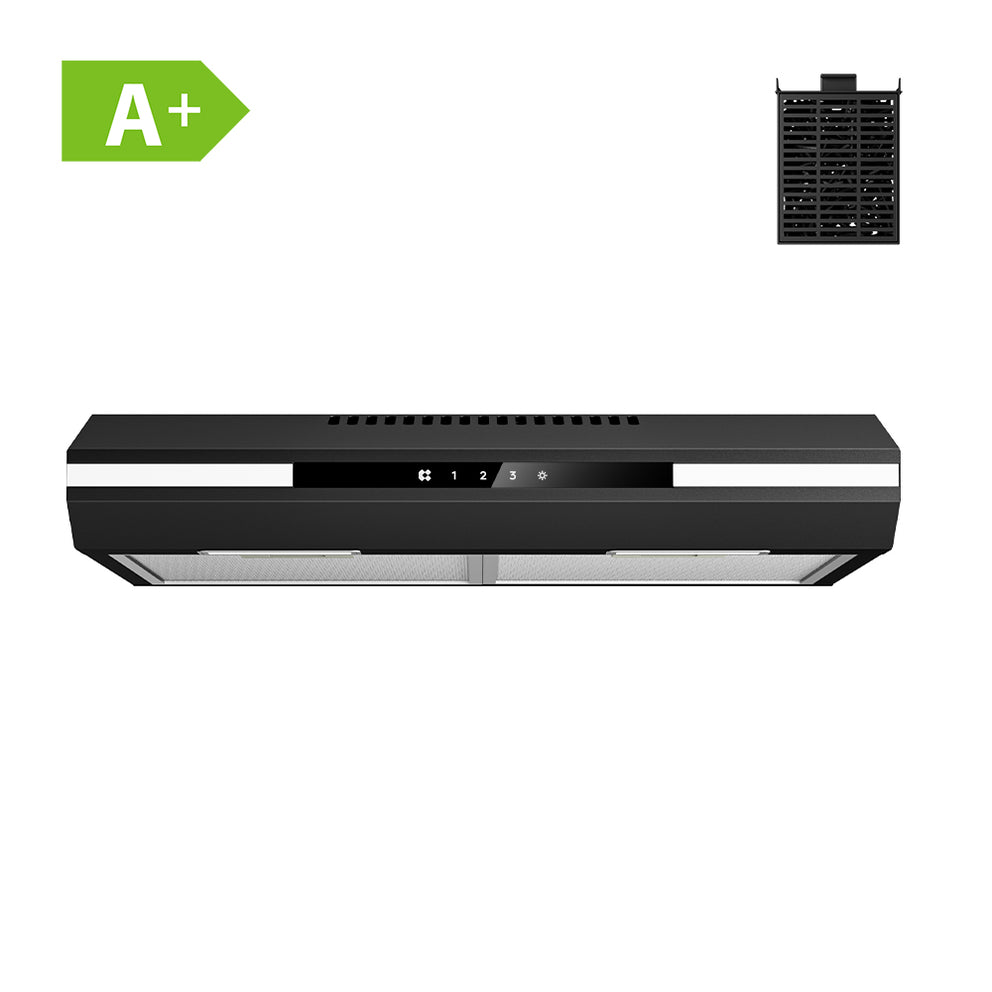
A visor cooker hood is a compact extractor hood that is generally fixed under a kitchen unit or directly to the wall, above the hob. More discreet and less bulky than a traditional decorative hood, it is particularly suitable for small kitchens and spaces where every centimetre counts. It allows you to extract smoke, steam, and cooking odours, while offering a practical and often more affordable solution. Depending on the model, it can operate with external ducting or in recirculation mode using a charcoal filter.

What is the Difference Between a Visor Cooker Hood and a Telescopic Cooker Hood?
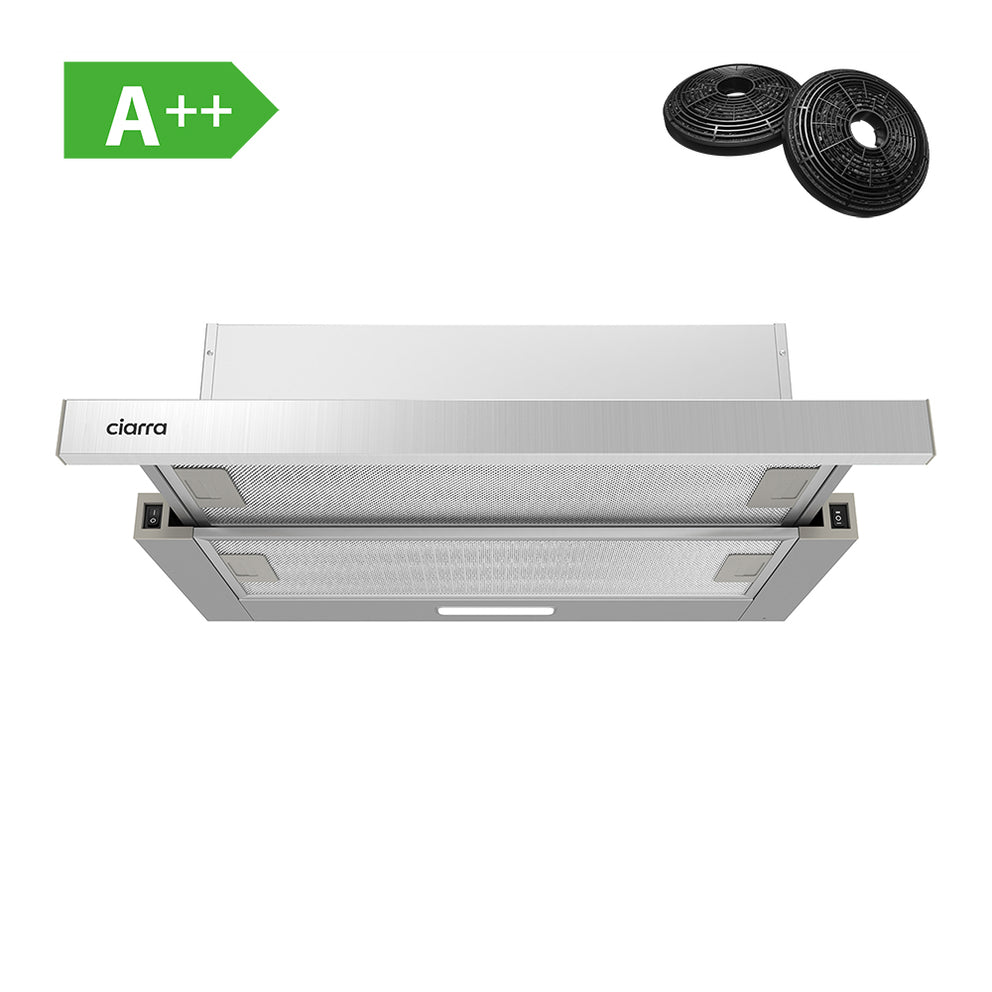
A visor cooker hood is a compact model that is generally fixed under a kitchen unit or directly to the wall. Its structure remains visible and it operates as soon as the user turns it on. A telescopic cooker hood, on the other hand, is integrated under a wall unit and features a sliding section that you pull out to switch the hood on or to increase the extraction surface area, depending on the model. The visor cooker hood is often simpler and more economical, while the telescopic hood offers a more discreet integration and a visual space gain. The choice depends on the kitchen layout, budget, and desired extraction performance.

Telescopic Cooker Hood
Visor Cooker Hood or Built-in Cooker Hood: What is the Difference?
A visor cooker hood is generally installed under a unit or fixed to the wall, with a visible part protruding above the cooking area.
A built-in cooker hood is designed to be integrated into a kitchen cabinet in order to blend seamlessly into the layout. The visor cooker hood is often easier to install and offers an economical solution for small kitchens. The built-in cooker hood prioritises aesthetics and discretion, but requires careful verification of the cabinet dimensions and mounting constraints. In both cases, it is important to compare the extraction rate, noise level, and the possibility of operating in ducting or recirculation mode.
Related: Visor Cooker Hood vs Integrated Cooker Hood

Built-in Cooker Hood
How does a visor cooker hood without ducting work?
A visor cooker hood without ducting operates in recirculation mode: it draws in air laden with smoke, grease, and odours, then passes it through a grease filter and an active charcoal filter. The grease filter traps fatty particles, while the charcoal filter helps reduce cooking odours.
The filtered air is then recirculated back into the kitchen without requiring an external duct. This system is particularly suitable for flats and kitchens that do not have an extraction outlet. However, it does not remove cooking humidity to the outside. To maintain good performance, it is important to clean the grease filter regularly and replace the charcoal filter according to the manufacturer's recommendations.
How Effective is a Visor Cooker Hood?
The efficiency of a visor cooker hood mainly depends on its extraction rate (expressed in m³/h), the size of the kitchen, and its operating mode. For a small kitchen, an extraction rate of around 250 to 400 m³/h may be suitable depending on the volume of the room and cooking habits. In ducting mode, the hood expels smoke, steam, and odours outside. In recirculation mode, it filters grease and reduces odours using a charcoal filter, but does not extract moisture out of the room. To achieve good performance, choose an extraction rate suited to your needs, clean the grease filters regularly, and replace the charcoal filter according to the manufacturer's recommendations.
Which Extraction Rate Should You Choose for a Visor Cooker Hood?
For a visor cooker hood, the extraction rate depends mainly on the volume of the kitchen, frequency of use, and cooking style. For a small kitchen, a rate of around 250 to 400 m³/h is generally suitable, whereas an open-plan kitchen or frequent frying and heavy smoke cooking may require a higher rate.
To estimate your needs, you can multiply the volume of the kitchen by 10 to 12 air changes per hour. For example, for a 10 m² kitchen with a ceiling height of 2.5 m, the volume is 25 m³: a theoretical extraction rate of 250 to 300 m³/h serves as a initial benchmark.
Also consider the operating mode: with external ducting, air is expelled outside, whereas in recirculation mode, grease and charcoal filters reduce fat particles and odours without extracting moisture.

How to Choose a Quiet Visor Cooker Hood?
To choose a quiet visor cooker hood, compare the noise level (dB), motor design, fan speeds, and installation conditions.
Noise level: compare decibels at different speeds. Less than 50 dB at low speed can be an interesting benchmark.
Motor and fan: a well-balanced motor, optimized ventilation, and appropriate acoustic insulation limit vibrations.
Adjustable speeds: choose at least three levels to adapt extraction to your needs and reduce noise when maximum power is not required.
Filters: clean grease filters regularly to maintain performance and limit noise disturbance.
Ducting: a duct with a suitable diameter and few bends promotes smoother airflow and can reduce noise.
Installation: mount the hood securely to prevent vibrations against the cabinet or wall and observe the height recommended by the manufacturer.
Tip: compare noise levels at equivalent extraction rates. A well-designed and properly installed hood can offer a good balance between quiet operation and efficiency.
To explore these criteria further, also consult our guide: How to choose the best quiet cooker hood?
Which Filters to Choose and How to Maintain a Visor Cooker Hood?
For a visor cooker hood, choose a washable metal grease filter to trap grease, and if your hood operates in recirculation mode, add an active charcoal filter to reduce odours.
How to Clean and Degrease the Grease Filter of a Visor Cooker Hood?
Yes, if permitted by the manufacturer. Check model instructions before washing, as some metal filters may discolour or suffer damage in a dishwasher. If machine washing is allowed, remove heavy grease residues and follow the manufacturer's temperature and programme recommendations.
Is it Possible to Wash the Metal Filter of a Visor Cooker Hood in the Dishwasher?
Yes, if permitted by the manufacturer. Check model instructions before washing, as some metal filters may discolour or suffer damage in a dishwasher. If machine washing is allowed, remove heavy grease residues and follow the manufacturer's temperature and programme recommendations.
When and How to Change the Charcoal Filter of a Visor Cooker Hood in Recirculation Mode?
The active charcoal filter generally needs replacing every 3 to 6 months, depending on cooking frequency and manufacturer recommendations. To replace it, switch off the hood, remove the grease filter, take out the old charcoal filter, and install a filter compatible with your model. Then replace the grease filter. Some charcoal filters are regenerable: check the manual before cleaning or reusing them.
What is the Price and Replacement Frequency of Filters for a Visor Cooker Hood?
The price depends on the type of filter and brand. As a guide, a compatible charcoal filter often costs £10 to £40, while a replacement metal filter can cost around £10 to £50, or even more depending on the model.
The metal grease filter is generally reusable and should be cleaned every 2 to 4 weeks, depending on cooking intensity. The charcoal filter is often replaced every 3 to 6 months. To manage maintenance costs, check filter availability, price, and compatibility before buying your hood.
How to Install a Visor Cooker Hood
Fix the visor cooker hood under a kitchen unit or directly to the wall, depending on the model. Check that the support is sturdy, follow the manufacturer's instructions, and connect the extraction duct if the hood operates in extraction mode. In recirculation mode, install compatible charcoal filters. Before starting, disconnect the power supply.
At what height should a visor cooker hood be installed?
The height depends on the type of hob and manufacturer recommendations. As a guide, generally allow 65 to 75 cm above an induction or electric hob, and 65 to 75 cm above a gas hob, unless stated otherwise in the manual. Always observe the minimum safety distance specified for your hood and hob.
Is it possible to install a visor cooker hood without a cabinet?
Yes, a visor cooker hood can be installed directly on the wall if the model is designed for this type of mounting. Make sure the wall and fixings can support its weight and that the installation height is appropriate. If the hood requires external ducting, also provide a compatible duct; in recirculation mode, check that air can be properly recirculated back into the kitchen.

Conclusion
The visor cooker hood is a practical choice to reduce smoke, grease, and cooking odours without cluttering your kitchen. To choose the right model for your needs, consider the room size, extraction rate, noise level, ducting mode, and filter maintenance ease. If your kitchen does not have an external outlet, a model operating in recirculation mode can be a suitable solution, provided you replace the charcoal filter regularly. Finally, proper installation height and regular maintenance will help preserve your hood's performance and ensure greater cooking comfort every day.
News

Sustaining Quality, Elevating Kitchens: The CIARRA Story So Far

From IFA to KBIS: Ciarra’s Global Expansion and 8-Year Milestone




Comments
There are no comments yet.