Portable induction hobs have become increasingly popular across the UK and Europe. Whether you're living in a small flat, renovating a kitchen, setting up a holiday home, or simply need extra cooking space, a portable induction hob can offer a convenient and energy-efficient solution.
However, many consumers quickly discover that not all portable induction cooktops deliver the same cooking experience. Online reviews are filled with complaints about weak heating performance, limited cookware compatibility, and confusing technical specifications.
Before choosing a portable induction hob, it's important to understand the most common frustrations buyers encounter and the key features that can help avoid them.
Why Are More Consumers Choosing Portable Induction Cooktops?
Several factors have driven the growing demand for portable induction hobs across Europe:
Rising energy costs encourage consumers to seek more efficient cooking solutions.
Small apartments and studio flats often lack sufficient kitchen space.
Holiday homes, caravans, and campervans require compact cooking equipment.
Many households need an additional cooking zone during family gatherings.
Induction technology offers faster heating and greater energy efficiency compared to traditional electric hot plates.
Despite these advantages, many first-time buyers discover unexpected limitations after purchasing a portable induction cooker.
Pain Point 1: Insufficient Heating Power – Why Many Buyers Feel Disappointed After Purchase
Among the many complaints surrounding portable induction cooktops, insufficient heating power is one of the most frequently discussed topics across online communities and consumer forums.
When researching buyer experiences on platforms such as Reddit, many consumers reported that their portable induction hobs struggled to deliver the performance they expected. While product listings often advertise impressive wattage figures, real-world cooking results can sometimes tell a different story.
Common complaints include:
- Water taking longer than expected to boil
- Difficulty achieving a strong sear on meat
- Slow heating when using cast iron cookware
- Reduced performance when cooking with larger frying pans or stockpots
- Noticeable power reduction when using dual-zone portable hobs
For many first-time buyers, the expectation is simple: if a portable induction hob is advertised as powerful, it should perform similarly to a built-in induction cooktop. However, the reality is that portable units operate under different electrical limitations.
Why Does This Happen?
The issue is not necessarily poor product design—it is often a matter of available electrical power.
In many online discussions, consumers point out that standard household plug sockets can only provide a limited amount of electricity. As a result, portable induction cooktops must operate within strict power constraints.
One Reddit user explained that while a portable induction hob may offer around 1500W to 2000W of power, a full-size built-in induction cooktop can deliver significantly more energy through a dedicated electrical circuit. In comparison, some built-in induction zones can exceed 3000W on a single cooking zone alone.
This difference becomes particularly noticeable when:
- Boiling large volumes of water
- Cooking with heavy cast-iron pans
- Preparing meals for multiple people
- Using cookware larger than 28cm
As a result, many consumers who expect restaurant-style searing performance from an entry-level portable hob may end up feeling disappointed.
How Much Power Is Actually Enough?
Based on discussions from experienced induction users, there appears to be a general consensus that power output plays a significant role in overall cooking satisfaction.
For most everyday cooking tasks, a portable induction hob offering around 1800W to 2000W of maximum power is generally considered sufficient for:
- Boiling water quickly
- Frying vegetables
- Cooking pasta and rice
- Preparing everyday family meals
For consumers who frequently use larger cookware, cast iron pans, or high-heat cooking techniques, higher power levels and efficient heat transfer become increasingly important.
Pain Point 2: Cooking Zones That Are Too Small – When Your Pan Is Bigger Than the Heating Area
Another issue that appears repeatedly in consumer reviews and online discussions is the size of the induction heating zone itself.
Many buyers assume that if a portable induction hob can physically accommodate a large frying pan, it will also heat the entire base evenly. Unfortunately, this is not always the case.
One of the most common complaints found across cooking forums is that the visible glass surface often appears much larger than the actual induction coil hidden underneath.
As a result, some users discover after purchase that their cookware is significantly larger than the hob's effective heating area.
Why Does Heating Zone Size Matter?
The induction coil located beneath the glass is responsible for generating heat within the cookware.
If the induction coil is considerably smaller than the base of the pan, the heat tends to concentrate in the centre while the outer edges receive less energy.
This becomes particularly noticeable when using:
- 28cm frying pans
- Large sauté pans
- Family-sized stockpots
- Cast iron skillets
- Griddles and oversized cookware
Consumers frequently report several frustrations:
- Uneven cooking results
- Hot spots in the centre of the pan
- Cooler temperatures around the edges
- Longer cooking times
- Poor searing performance
- Difficulty cooking large portions evenly
For example, several experienced induction users on Reddit noted that some budget portable induction hobs may use relatively small induction coils despite advertising compatibility with larger cookware.
In practice, the pan may fit perfectly on the hob, but only the centre section receives the strongest heat.
Why This Is More Noticeable with Larger Cookware
The issue becomes increasingly obvious as cookware size increases.
A small saucepan may perform perfectly well because its base closely matches the heating zone.
However, when cooking with a 28cm frying pan or a large cast iron skillet, a small induction coil can leave significant portions of the cooking surface underheated.
For consumers who regularly prepare meals for families or enjoy cooking with larger pans, this can become a major source of frustration.

The Mistake Many Buyers Make
One of the most common purchasing mistakes is focusing entirely on the induction hob specifications while ignoring the cookware that will be used on it.
In reality, cookware size and induction zone size should always be evaluated together.
Many consumers only discover compatibility issues after purchase when they notice uneven browning, inconsistent cooking temperatures, or longer cooking times.
Before selecting a portable induction hob, first identify the cookware sizes you use most often.
If your kitchen primarily relies on 24cm to 28cm frying pans, large stockpots, or cast iron cookware, choosing an induction hob with a larger heating zone should be a priority.
Many consumers focus on power output alone, but real-world cooking performance is often determined by how well the induction coil matches the cookware sitting on top of it.
Pain Point 3: Difficulty Comparing Product Specifications
One of the biggest challenges for buyers is understanding which specifications actually matter.
Product listings often highlight:
- Wattage
- Temperature ranges
- Power levels
- Timer functions
- Safety features
Yet many consumers still struggle to determine which model will perform best in real cooking situations.
What Buyers Should Focus On
Rather than relying solely on marketing claims, focus on practical features such as:
- Stable temperature control
- Responsive power adjustment
- Heating consistency
- Noise levels
- Ease of cleaning
These factors often have a greater impact on daily cooking satisfaction than headline specifications alone.
Key Features to Prioritize When Buying a Portable Induction Hob
To avoid common frustrations, consumers should focus on the following factors:
Powerful and Consistent Heating
Look for a model capable of maintaining stable heat during extended cooking sessions.
Larger Cooking Zone
A larger induction area helps ensure more even heat distribution across cookware.
Wide Cookware Compatibility
The hob should work effectively with common household cookware, including cast iron and induction-ready stainless steel.
Precise Temperature Control
Multiple power and temperature settings provide greater cooking accuracy.
Safety Features
Important features include:
- Pan detection
- Overheat protection
- Child lock
- Automatic shut-off
- Easy Maintenance
A smooth glass surface makes cleaning quicker and easier than traditional electric hot plates.
Recommended CIARRA Portable Induction Hobs for Different Cooking Styles
CIARRA Donut Portable Single Induction Hob 2000W
For consumers concerned about the power limitations often discussed in online forums, the CIARRA Donut Portable Single Induction Hob offers up to 2000W of power, which falls within the range many experienced induction users consider ideal for a portable single-burner cooktop. It provides enough power for everyday tasks such as boiling water, frying, sautéing, and cooking with cast iron cookware without requiring a built-in installation.

Another common concern among buyers is cookware compatibility. The Donut induction hob supports magnetic cookware with a base diameter ranging from 12cm to 24cm, covering most of the saucepans, frying pans, stainless steel cookware, and cast iron skillets commonly found in UK and European kitchens. If your existing cookware falls within this size range, you can confidently choose this induction hob without worrying about compatibility issues.

Key features include:
- Up to 2000W Power Output
- 8 Power Levels and 8 Temperature Settings
- 4-Hour Timer with Touch Control
- Compatible with cookware sizes 12–24cm
- Durable and easy-to-clean Ceramic Glass Surface
For added peace of mind, it also includes essential safety features such as Child Lock, Automatic Pan Detection, Overheat Protection, Overflow Protection, and Automatic Safety Shut-Off, making it a practical choice for apartments, dormitories, caravans, and everyday home cooking.

Portable Single Induction Hob 2000W
CIARRA Donut
Discover the CIARRA Donut 2000W portable induction hob with 8 power levels, 12–24cm cookware compatibility, touch controls, and advanced safety features for everyday cooking.
CIARRA Portable Double Induction Hob 3500W
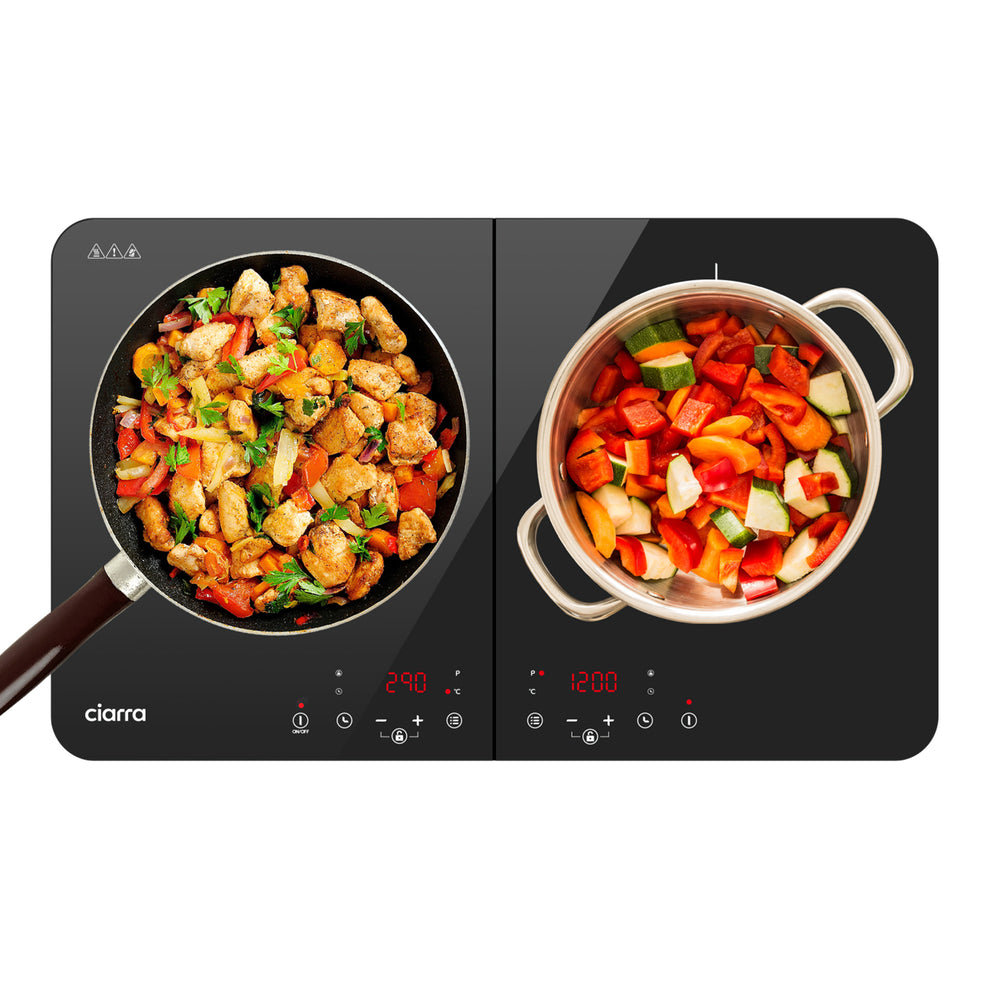
For consumers who frequently cook multiple dishes at the same time, the CIARRA Portable Double Induction Hob offers greater flexibility than a traditional single-burner model. While each cooking zone can deliver up to 2000W of power, the dual-zone design allows users to boil, fry, simmer, or prepare side dishes simultaneously, making meal preparation faster and more convenient.
Compared to a single induction hob, the biggest advantage is the ability to manage multiple cooking tasks at once. Whether you're preparing a family dinner, cooking pasta while making a sauce, or using separate pans for different ingredients, the dual cooking zones help streamline the entire cooking process.

Another key benefit is its wider cookware compatibility. Supporting induction-compatible cookware from **12cm to 28cm**, it accommodates everything from small saucepans to large frying pans, cast iron skillets, and family-sized stockpots. If your kitchen already uses cookware within this size range, there is no need to purchase additional pots or pans.
Key features include:
- 3500W Total Power Output
- Up to 2000W Per Cooking Zone
- Dual Cooking Zones with Independent Controls
- 9 Power Levels (200W–2000W)
- 10 Temperature Settings (60°C–240°C)
- Compatible with cookware sizes 12–28cm
- Slim, Portable Design with Durable Ceramic Glass Surface
For everyday safety and convenience, the hob also includes Child Lock, Automatic Pan Detection, Automatic Shut-Off, and Timer Functions, helping provide a safer and more user-friendly cooking experience.
For households that need more cooking capacity without installing a full-size built-in hob, this dual induction cooktop offers an excellent balance of power, flexibility, and cookware compatibility.

CIARRA Portable Double Induction Hob 3500W
Ciarra CBTIH2-OW
Cook more efficiently with the CIARRA 3500W double induction hob, featuring dual cooking zones, 12–28cm cookware compatibility, precise temperature control, and built-in safety functions.
| Feature | CIARRA Donut Portable Single Induction Hob | CIARRA Portable Double Induction Hob |
|---|---|---|
| Cooking Zones | 1 Zone | 2 Independent Zones |
| Maximum Power | 2000W | 3500W Total (Up to 2000W per Zone) |
| Cookware Compatibility | 12–24cm | 12–28cm |
| Power Levels | 8 Levels | 9 Levels |
| Temperature Settings | 8 Settings | 10 Settings (60°C–240°C) |
| Timer | Up to 240 Minutes | Built-in Timer Function |
| Safety Features | Child Lock, Pan Detection, Overheat & Overflow Protection | Child Lock, Pan Detection, Automatic Shut-Off |
| Best For | Singles, Couples, Small Kitchens, Camping | Families, Multi-Dish Cooking, Larger Cookware |
Conclusion
Portable induction cooktops offer an excellent solution for modern households seeking flexibility, energy efficiency, and space-saving convenience. However, many consumers encounter common challenges such as limited heating power, small cooking zones, cookware compatibility concerns, and confusion over technical specifications.
Understanding these pain points before making a purchase can help consumers choose a model that better suits their cooking habits and kitchen environment.
News

Sustaining Quality, Elevating Kitchens: The CIARRA Story So Far
From IFA to KBIS: Ciarra’s Global Expansion and 8-Year Milestone