Do electric radiators consume a lot of electricity? How much does it cost to keep it running every day? Is it possible to reduce electricity costs without sacrificing a comfortable temperature?
If you are looking for an energy-efficient electric radiator, the most important thing is not to focus solely on its power rating or the energy-saving features advertised by the manufacturer. The actual cost depends on how many hours the heating runs, the temperature selected, the insulation of your home, and the price you pay for each kWh of electricity.
A 1,000 W, 1,500 W, or 2,000 W electric radiator can be a suitable solution for heating a room, but its monthly consumption will vary depending on how you use it. In addition, features such as a digital thermostat, weekly programming, and open-window detection can help you avoid unnecessary energy consumption.
In this guide, we explain how much a thermal radiator costs to run per month, how to calculate its cost, and which features you should consider when choosing an efficient model for your home.

Does an electric radiator consume a lot of electricity?
An electric radiator converts electricity into heat. Therefore, its consumption depends mainly on its electrical power and the length of time it spends heating.
For example, a 1,500 W appliance consumes 1.5 kWh for every hour of continuous operation at rated power. However, this does not necessarily mean that it consumes that amount during every hour it remains switched on.
When the room reaches the selected temperature, the thermostat can reduce or interrupt the heat output. Actual consumption will depend on the room's heat losses and how often the appliance needs to heat again.
Energy-efficient electric heater: calculating electricity costs by power rating
To calculate the running cost, use this formula:
Electricity consumption (kWh) = power (kW) × effective operating hours
Electricity cost = consumption (kWh) × electricity price (€/kWh)
For the following examples, we will use an indicative price of €0.20/kWh. This is not a universal tariff or a price forecast: you should replace it with the actual price shown on your electricity bill.
How much does it cost to use a 1,000 W, 1,500 W, or 2,000 W thermal radiator?
| Power | Consumption in 1 hour | Cost per hour | Cost for 5 hours | Cost for 8 hours |
|---|---|---|---|---|
| 1,000 W | 1 kWh | €0.20 | €1.00 | €1.60 |
| 1,500 W | 1.5 kWh | €0.30 | €1.50 | €2.40 |
| 2,000 W | 2 kWh | €0.40 | €2.00 | €3.20 |
These amounts represent continuous operation at rated power. If the thermostat interrupts heating for part of the time, consumption may be lower.
For example, a 1,500 W radiator operating at full power for five hours would consume 7.5 kWh, costing €1.50 at €0.20/kWh.
By contrast, if it only needs to provide heat for the equivalent of three hours at full power during those five hours, it would consume 4.5 kWh and cost €0.90.
This difference explains why actual consumption does not depend solely on the wattage shown on the label.
How much does an electric radiator cost to run per month?
To determine the monthly cost, multiply daily consumption by the number of days of use.
The following table compares three power ratings with different effective operating times, assuming 30 days of use and an electricity price of €0.20/kWh.
| Power | Effective daily use | Monthly consumption | Estimated monthly cost |
|---|---|---|---|
| 1,000 W | 3 hours | 90 kWh | €18 |
| 1,000 W | 5 hours | 150 kWh | €30 |
| 1,000 W | 8 hours | 240 kWh | €48 |
| 1,500 W | 3 hours | 135 kWh | €27 |
| 1,500 W | 5 hours | 225 kWh | €45 |
| 1,500 W | 8 hours | 360 kWh | €72 |
| 2,000 W | 3 hours | 180 kWh | €36 |
| 2,000 W | 5 hours | 300 kWh | €60 |
| 2,000 W | 8 hours | 480 kWh | €96 |
Important: the hours in this table are equivalent hours of operation at rated power, not necessarily the number of hours the radiator remains switched on. In real conditions, the thermostat may cause the appliance to heat intermittently.
Practical example: a 1,500 W electric radiator in the living room
Imagine that you use a 1,500 W thermal radiator for six hours a day, but the thermostat maintains the heat with operation equivalent to three hours a day at full power.
The calculation would be:
Rated power: 1.5 kW.
Equivalent operating time: 3 hours per day.
Daily consumption: 1.5 × 3 = 4.5 kWh.
Monthly consumption: 4.5 × 30 = 135 kWh.
Monthly cost at €0.20/kWh: €27.
If, due to poor insulation, the appliance needed to heat for the equivalent of five hours at full power each day, the monthly cost would rise to €45.
Therefore, two homes using the same model for six hours a day may have different electricity bills. The outdoor temperature, windows, walls, and selected temperature all influence how much heat the room needs.
Which electric radiator consumes the least energy?
Ceramic radiators incorporate a core that stores heat and can continue releasing it for some time after the heating element stops supplying energy.
This feature can provide a more gradual feeling of warmth and help distribute heat output over time.
However, heat storage does not automatically mean that the appliance consumes less electricity to provide the same amount of useful heat. Resistive electric heaters convert practically all the electricity they consume into heat within the room, although they differ in response speed, heat distribution, and the way they regulate it.
A ceramic radiator may be a good choice if you value gradual warmth and residual heat output. A convector may be appealing if you want a quick response. In both cases, regulation and usage habits are essential for controlling your electricity bill.
You may be interested in:
How to save energy with an energy-efficient electric radiator
Power is only one of the factors that determine the cost. When choosing a low-consumption thermal radiator, you should also consider how it is used and how much heat the room loses.
1. The thermostat: maintaining the temperature without heating continuously
A digital thermostat allows you to select a temperature and regulate the radiator's operation to maintain it.
For example, if you select 20 °C, the appliance does not need to continue heating at full power once the room reaches that temperature. When the room cools down, it provides heat again as needed.
An accurate thermostat can prevent overheating and improve consumption control. However, it does not magically reduce the electricity needed to compensate for a room's heat losses.
2. Weekly programming: heating only when you need it
Programming allows you to adapt heating schedules to your daily routine.
You can use Comfort mode when you are at home, lower the temperature while you are away, and activate anti-frost mode when appropriate.
For example, if you normally leave home at 8:00 and return at 18:00, it does not always make sense to maintain the same comfort temperature throughout the day. Lowering it while you are away can reduce heat losses.
Weekly programming also helps prevent the radiator from heating an empty room simply because you forgot to switch it off.
3. ECO mode: lowering the target temperature
ECO mode usually maintains a lower temperature than Comfort mode. By lowering the room temperature, the difference between indoor and outdoor temperatures decreases, and therefore the amount of heat lost is reduced.
Actual savings depend on how much you lower the temperature, how long you maintain it, and your home's insulation. There is no universal savings percentage that applies to every household.
4. Open-window detection
Ventilation is necessary, but keeping the heating running while cold air enters can waste energy.
Some radiators include an open-window detection function that temporarily interrupts or reduces heating when it detects a sudden drop in temperature.
This function can help prevent unnecessary energy consumption during ventilation. Its effectiveness depends on how it detects the temperature drop and the conditions of use.
5. Home insulation
Insulation can have as much impact on consumption as the choice of appliance.
Leaky windows, cold walls, poorly fitted doors, and inadequately insulated ceilings cause a room to lose heat more quickly.
To improve efficiency:
- Close doors and windows while using the heating.
- Check that windows close properly.
- Lower the blinds at night if this helps reduce heat loss.
- Avoid covering the radiator with clothes, curtains, or other objects.
- Prioritise heating the rooms you use.
- Adjust the temperature to your needs, avoiding unnecessarily high settings.
Which type of energy efficient electric radiator is best?
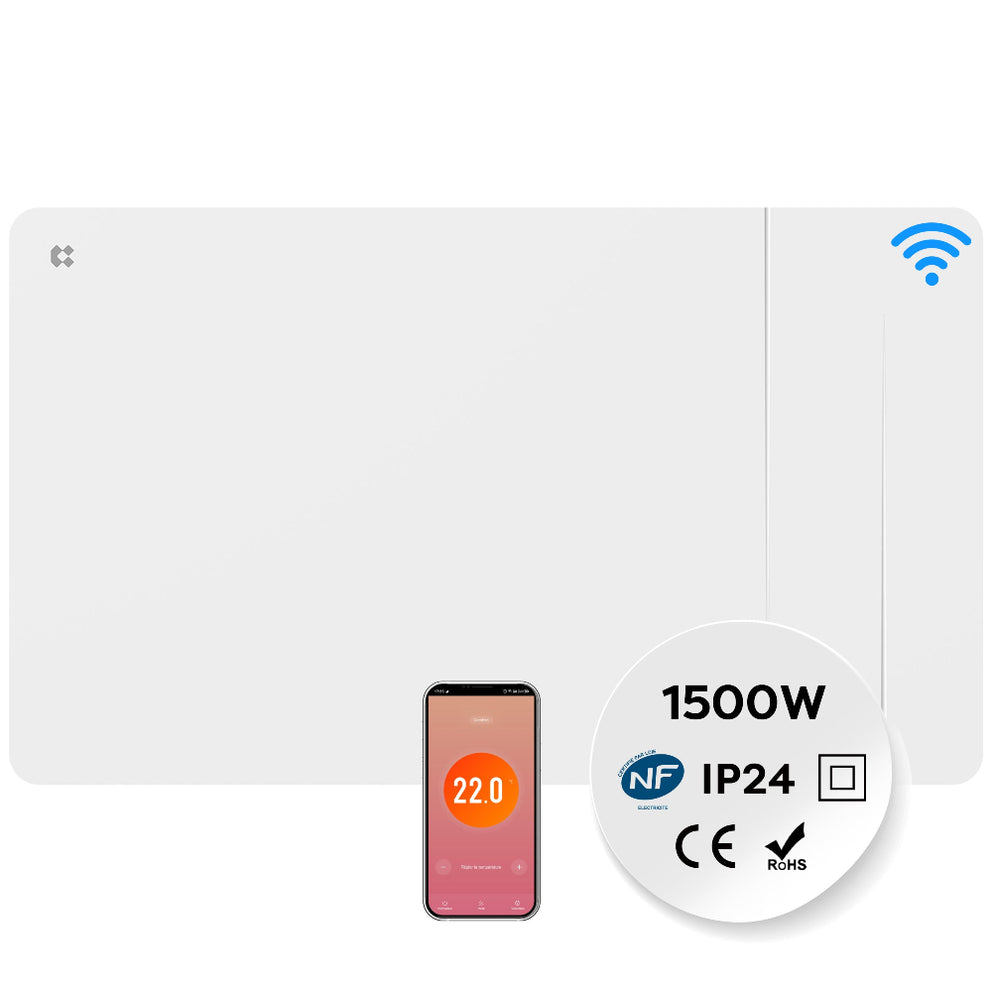
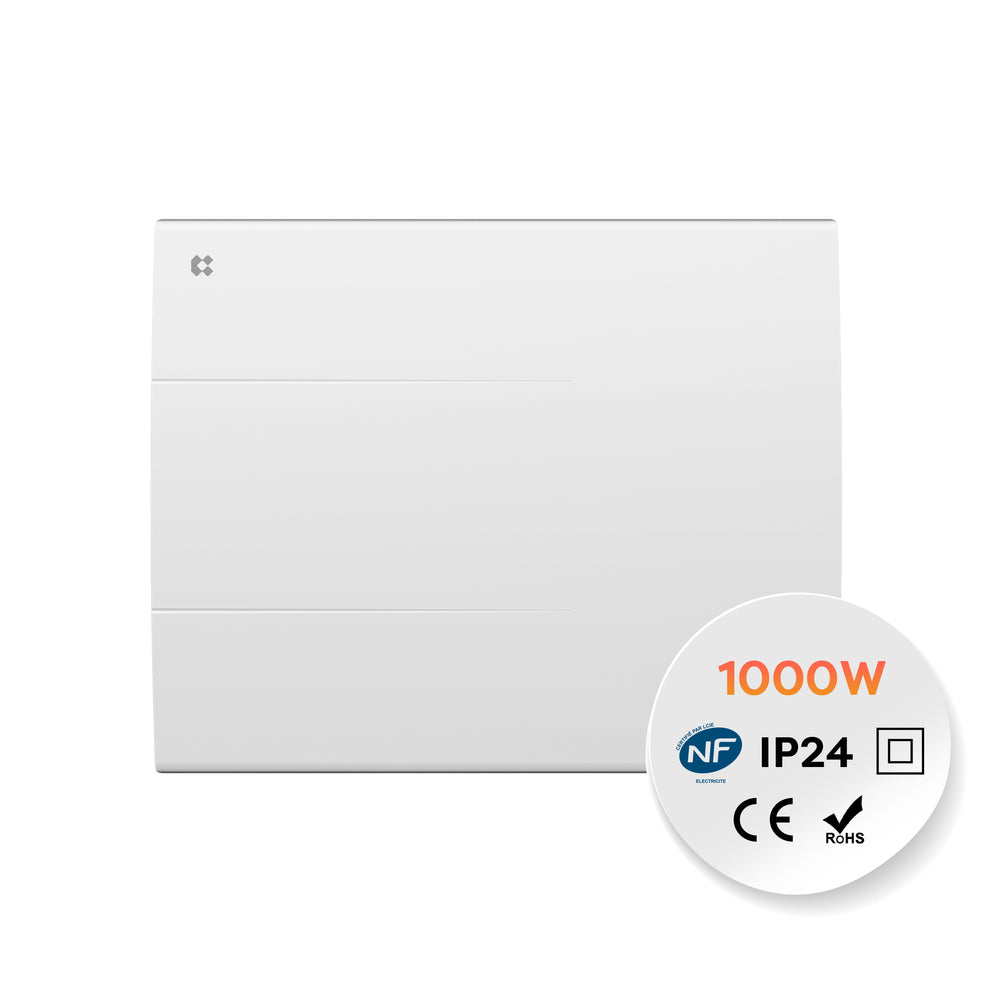
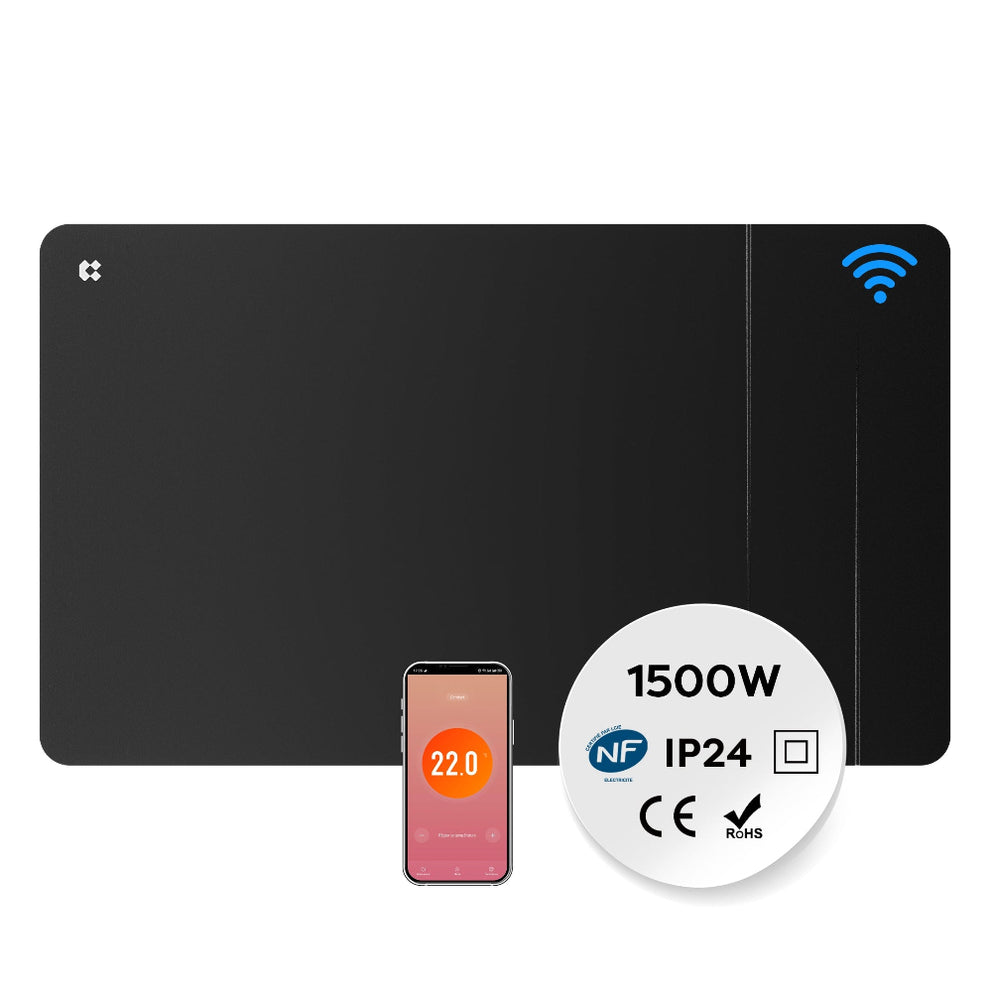
CIARRA offers different solutions for people who want better control over home heating: a Wi-Fi convector, ceramic radiators with smart controls, and a ceramic model without an internet connection.
The main difference is not that one model always consumes less than another, but rather the combination of power, heating technology, programming, and control convenience.
How we test Ciarra electric radiators
When we test a Ciarra radiator, we switch it on at home rather than simply analysing its specifications on paper, and compare it side by side with the other models in the comparison. We put all Ciarra radiators through three identical tests in the same room, adapting the measurement method to the control system integrated into each model (from traditional controls to its digital display or smart app control). We focus on the real day-to-day experience: how long it takes to heat up, the energy cost of keeping it switched on, and how efficiently it maintains the temperature.
The three tests that determine Ciarra's score
Thermal performance: We start with an average room temperature of 17 °C and run the appliance at maximum power for 90 minutes. We place thermometers at 1 m and 3 m to measure temperature changes every 15 minutes, checking how long it takes for the heat to become noticeable and whether it continues to emit heat after being switched off.
Consumption: We run a 4-hour cycle, maintaining the room at 21 °C with the door closed and the appliance connected to an energy meter. This allows us to record what percentage of the time it is actually consuming electricity relative to its declared power.
Programming and smart features: We check the effectiveness of its weekly programming options and connectivity (such as the Ciarra app or control via). We assess how accurately it starts and stops at the scheduled times, as well as the operation of the child lock and open-window detection system.
How we calculate the score
The final score for each Ciarra radiator is the simple arithmetic mean of three criteria, each evaluated independently out of 10 (without weighting; all three count equally):
- Thermal performance
- Consumption
- Programming
Note on the ranking: The score measures how the model performs in these three objective tests. However, its final position in the comparison also depends on editorial factors, such as value for money, the usefulness of its smart features, and the type of home or space it is designed for.
| Comparison Dimension | CBHX20-B | Kuba (CBHT10E / 15E / 20E) | HAVEN (CBHTD10A-W / 15A-W / 15A-B / 20A-W) |
| Test Score | 8.8 | 9.0 | 9.5 |
| Product Type / Heating Principle | Convector radiators (glass panel, top air outlet) | Ceramic storage radiators (single thermal core) | Dry ceramic storage radiators · Dual thermal core |
| Available Models / Power | Single model rated at 2000W (nominal 1680–2000W) | 3 models: 1000W / 1500W / 2000W | 3 models: 1000W / 1500W / 2000W (includes black model 15A-B) |
| Power Supply | 220–240V~ 50/60Hz | 230V~ 50Hz | 230V~ 50Hz |
| Electrical Class | Class I (mandatory earth connection required) | Class II, double insulation (earth connection prohibited) | Class II, double insulation (earth connection prohibited) |
| Protection Rating | IP24 | IP24 | IP24 |
| Installation / Wiring | Standard power outlet (plug); wall-mounted or floor-standing with support feet | Fixed wiring required, installed by a qualified electrician (the manual expressly states "do not connect via a plug"), 3 wires including a pilot wire (pilote) | Fixed wiring required, installed by a qualified electrician (the manual expressly states "do not connect via a plug"), 3 wires including a pilot wire (pilote) |
| Temperature Adjustment Range | 5–35 °C | Comfort: 5–29 °C; ECO: automatically reduces temperature by 3.5 °C (1.5–25.5 °C) | Comfort: 5–29 °C; ECO: automatically reduces temperature by 3.5 °C (1.5–25.5 °C); temperature calibration of ±9 °C |
| Power Levels / Modes | L (50% power) / H (maximum power) / ECO / UP weekly programming / Open-window detection | Comfort / ECO / Pre-installed programmes P1, P2, P3 / Customisable weekly programme P9 / P (pilot wire) / Anti-frost mode at 7 °C | Same as Kuba (P9 can be configured hour by hour on the control panel) |
| Shutdown Timer | 0–8 hours | No independent timer (via weekly programming) | No independent timer (via weekly programming) |
| Smart Connectivity | 2.4G Wi-Fi (Smart Life) | No network functions | 2.4G Wi-Fi, compatible with TuyaSmart + Smart Life; radio frequency 2412–2472 MHz, ≤19.5 dBm |
| Energy Consumption Display | Not specified | Indicator light that changes colour according to temperature (≤19 °C Green / 19–24 °C Yellow / >24 °C Red) | Electricity consumption and cost display: configurable power and tariff (default €0.20/kWh), cost tracking for 1 day / 7 days / 30 days / 365 days / previous day, reset function available |
| Seasonal Energy Efficiency | Not specified in the manual | 92.0% | 94.0% |
| Standby / Idle Consumption | Not specified | 0.37 W (idle: 0.41 W) | 0.42 W (idle: 0.87 W) |
| Usage Restrictions According to the Manual | Explicit statement: Suitable only for well-insulated spaces or occasional use | No restrictions specified | No restrictions specified |
| Bathroom Installation | Zone 2 or outside the zones only | Zone 2 or outside the zones only (NFC 15-100 standard: distance ≥60 cm from the bath or shower) | Zone 2 or outside the zones only (same requirement) |
| Behaviour After a Power Cut | — | Retains settings, temperature, and thermostat mode; the clock time must be reset | Same as the previous model; the clock icon on the display flashes as a warning |
| Shared Safety Features | Open-window detection (Kuba / HAVEN automatically switches to 7 °C anti-frost mode when a sudden drop is detected; CBHX20-B switches off automatically if the temperature drops by 4 °C within 30 minutes and resumes when it rises by 2 °C) · Keypad / child lock · Automatic backlight shutdown after 3 minutes · Domestic use only |
CIARRA CBHX20-B: 2,000 W Wi-Fi Convector
Listed price: €179.99
The CIARRA CBHX20-B is an electric convector designed for people who need to heat a room quickly and want to adapt their heating to their schedule. Its X-shaped aluminium heating element promotes a rapid thermal response through natural convection.

Our reasons for recommending it
At a price slightly above €180, this model features a large aluminium heating element that reaches an actual maximum power of 1950 W in testing, as well as a low-power mode that consumes an actual 1050 W. Its thermostat covers a range of 5 to 35 °C, and the manufacturer claims coverage of up to 20 m², a larger area than that of several competitors with similar power ratings. It offers the best value for money in our guide.
It offers three control methods: Wi-Fi connectivity, a mobile app, and an LED display on the appliance itself. It also includes overheating protection and IP24 splash-proof certification. It has a programmable timer from 1 to 8 hours to limit usage time, as well as weekly programming to adjust the temperature according to your routine.
It is equally practical when wall-mounted or standing on the floor, as all the brackets, screws, and feet are included in the box, so you do not need to decide how to install it before buying it.
Weak points
The model name does not exactly reflect its power. For example, although it is called "2000", its actual rated power is 1950 W.
Dual installation + Plug-in connection: It is the only one of the three models that supports portable floor-standing use and direct connection to a power outlet.
Direct shutdown timer (0–8h): The Kuba and HAVEN models only offer full weekly programming.
Half-power mode (L) and 5–35 °C range: Allows you to manually reduce the operating power by half.
Who is it for?👤
Tenants or finished homes: People looking for a ready-to-use solution that requires no construction work or electrician, and is easy to take along when moving.
Supplementary or transitional heating: Ideal for home offices, secondary bedrooms, Zone 2 bathroom areas, or temporary workspaces.
Users who prefer scheduled shutdown: Ideal for people who want the heating to switch off automatically at night instead of keeping it running continuously.

Main advantages
✅ Equipped with a highly efficient aluminium heating element (with an internal X-shaped structure). This is a single piece of aluminium with dense fins that quickly absorbs cold air, heats it, and redistributes it through convection. It delivers an actual power output of 1950 W, Wi-Fi connectivity, and an adjustable thermostat from 5 to 35 °C for just over €180.
Main disadvantages❌
- Insufficient performance in large or poorly insulated rooms.
- No heat retention: the room cools down quickly when the appliance is switched off.
- Weekly programming depends on 2.4G Wi-Fi connectivity.
- Weekly programming can only be configured through the app.
- Class I appliance: requires a reliable earth connection. Seasonal energy efficiency is not specified in the manual.
Kuba · Ceramic Storage radiators (CBHT10E / 15E / 20E) - €119.99
1000W / 1500W / 2000W · No network connection · Standby consumption of 0.37W · Pilot wire support

Reasons to recommend it
- 100% control from the panel: No need to register accounts or connect to Wi-Fi networks. The clock settings and P9 programming are configured directly on the appliance.
- Ultra-low standby consumption of 0.37W: The lowest value among the three compared models (0.41W in idle mode).
- Ceramic heat-storage core: Releases heat gradually and consistently, providing a comfortable thermal sensation similar to central heating.
- Three power options (1000 / 1500 / 2000W): Allows you to choose the appropriate capacity according to the size of the room.
- Three-wire connection with pilot wire (pilote): Compatible with the pilot-wire programmers commonly used in French installations.
- Seasonal energy efficiency of 92.0%.
Weak points (Comparative perspective)
- Its value (92.0%) is lower than that of the HAVEN model (94.0%).
- It has no network functions or remote control.
- It lacks a display for electricity cost information; it only has a colour indicator light (≤19 °C Green / 19–24 °C Yellow / >24 °C Red).
- It has a single heating element, so its thermal inertia is lower than that of dual-core systems.
- After a power cut, the clock time must be reset to maintain the accuracy of weekly programmes.
Who is it designed for?
- Older people or users who prefer simplicity: Intuitive physical controls without technological complications.
- Homes focused on privacy and low radiation: Ideal for people who prefer to avoid network-connected devices at home.
- Homes with pre-installed pilot-wire wiring: Allows integration into existing centralised control systems.
Key unique advantages
- Complete independence from Wi-Fi and apps: All functions are managed entirely through the appliance's control panel.
- Optimised standby consumption of 0.37 W.
HAVEN · Dry Ceramic Storage radiators (CBHTD10A-W / 15A-W / 15A-B / 20A-W)
Dual thermal core · 94.0% efficiency · Cost monitoring · ±9 °C calibration · Compatible with dual apps

Reasons to recommend it
- Dual-core ceramic heat storage: An exclusive configuration of this model that provides the greatest heat retention capacity and continuous heat output.
- Electricity cost monitoring: Allows you to enter the appliance's power rating and electricity tariff (default €0.20/kWh) to view estimated costs for 1 day, 7 days, 30 days, 365 days, or the previous day.
- Temperature calibration of ±9 °C: Allows you to correct discrepancies between the sensor reading and the actual temperature perceived in the room.
- Seasonal energy efficiency of 94.0%: The highest in the comparison.
- Dual compatibility with TuyaSmart and Smart Life: Easy integration into existing smart home ecosystems.
- Finish options: Available in white and black (model 15A-B).
Weak points (Comparative perspective)
The connectivity module increases idle consumption to 0.87W (standby consumption: 0.42W).
It requires a short learning period to configure hourly programming and cost parameters.
Professional installation with fixed wiring by a qualified electrician is required.
Compatible exclusively with 2.4 GHz Wi-Fi networks.
Who is it designed for?
Homeowners and long-term residents: People looking for a fixed, efficient, high-performance installation.
Energy-conscious users: Ideal for people who want to monitor heating costs in real time.
Main rooms and living rooms: The dual-core technology maintains a stable and comfortable temperature in larger spaces.
Smart homes: Perfect for integration with the TuyaSmart or Smart Life platforms.
Key unique advantages
Dual thermal core + dry ceramic heat storage: Provides greater thermal stability and prolonged thermal inertia.
Display panel for electricity costs and consumption.
Temperature calibration (±9 °C) and maximum seasonal efficiency (94.0%).
Which CIARRA radiator offers the best balance between consumption and convenience?
When comparing costs, remember that a 1,000 W radiator operating at full power for three hours consumes 3 kWh per day, while a 2,000 W radiator consumes 6 kWh under the same conditions.
However, if the higher-powered appliance needs to operate for less time to reach the desired temperature, the difference in effective consumption may be smaller. The important thing is to compare appliances suitable for the same room and under similar usage conditions.
FAQs
Do ceramic thermal radiators save electricity?
A ceramic core can store heat and release it gradually, but this does not guarantee lower consumption when producing the same amount of useful heat. Savings depend especially on the thermostat, programming, selected temperature, and room insulation.
Does ECO mode really reduce the electricity bill?
It can help reduce costs because it maintains a lower target temperature than Comfort mode. The amount saved depends on the temperature reduction, its duration, and the thermal conditions of the home.
Is a Wi-Fi thermal radiator better?
Wi-Fi is useful if you want to change schedules from your phone, switch the appliance off remotely, or adapt the heating to a variable routine. If you always follow the same schedule, a model with built-in programming may be sufficient.
What temperature should you select to save energy?
It is advisable to choose a temperature that provides comfort without overheating the room. As a general reference, many people use around 19–21 °C in occupied rooms, adjusting the setting according to their activity, clothing, and preferences. Lowering the temperature when you are away can help reduce consumption.
Conclusion
When choosing a low-consumption thermal radiator, do not focus solely on wattage or energy-saving claims. Check the recommended power for your room, thermostat accuracy, weekly programming, ECO mode, and the characteristics of your home.
If you are looking for rapid heating and portability, a convector such as the CIARRA CBHX20-B may be suitable. If you prefer ceramic heat and simple controls, the CIARRA model without Wi-Fi is an interesting alternative. If you value remote management, the smart models allow you to adjust the heating to your schedule.
News

Sustaining Quality, Elevating Kitchens: The CIARRA Story So Far

From IFA to KBIS: Ciarra’s Global Expansion and 8-Year Milestone